

Ever watched Finding Nemo and thought, “Why does this story just work so well?” That’s because it’s built on a simple yet powerful storytelling framework out there – the story spine. And it might be just what you need to save your story (and your sanity). So, stick around, and I’ll walk you through how to use The Story Spine like a pro.
What Is a Story Spine?
The story spine is basically the cheat code for writing a story that actually works, from beginning to end and everything in between. And no, it wasn’t invented by some storytelling wizard at Pixar (but they did help make it famous).
The real credit goes to Kenn Adams, an improv teacher who gave his students eight sentence starters to help them build full stories on the fly.
His idea? If you give people the right bones, they’ll naturally build the flesh around them.
And it blew up like this:
In 1997, Rebecca Stockley (who worked at Pixar) took Kenn’s improv class. She was obsessed with the story spine and brought it back to Pixar HQ. Her team loved it.
And then came the hits. We’re talking:
- Finding Nemo
- The Incredibles
- Monsters Inc.
- Up
- Toy Story 2 & 3
All story-spined, and of course, all box-office hits.
What’s the Story Spine Formula?
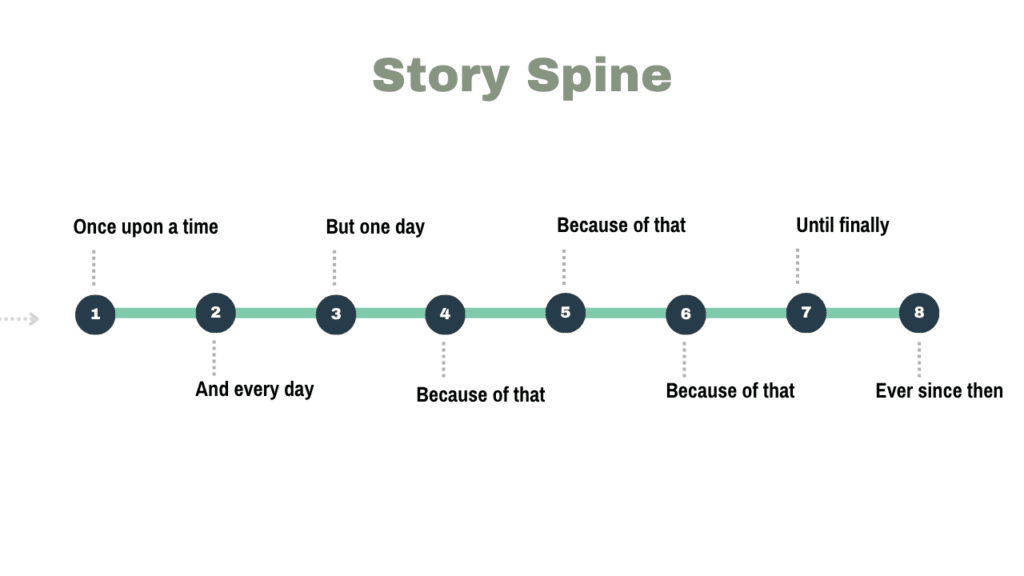
The story spine formula works like a fill-in-the-blank map for your plot. It helps you figure out where your story starts, how it builds, and where it lands, all without getting lost in the weeds.
Think of it as training wheels for your narrative arc: simple, sturdy, and designed to keep your story from face-planting. Keep in mind that it’s not a script, nor a rulebook.
Here’s the full structure:
- Once upon a time…
- And every day…
- But one day…
- Because of that…
- Because of that…
- Because of that…
- Until finally…
- And ever since then…
How to Make a Story Spine Using ChatGPT
If you’re about to create your story spine framework and don’t know where to start, your writing partner, who will never run out of ideas, aka ChatGPT, can help you fill in the gaps without overthinking it.
Ready to see how it works versus Save the Cat? Let’s break it down.
1. Once Upon a Time
This is your “setting the stage” moment. You’re not diving into the action just yet; you’re letting your readers (or viewers) peek into the world before things get messy.
Also, you don’t have to literally write “Once upon a time,” unless you want to. But the phrase is really just a stand-in for:
Introduce the world. Show us who your character is before everything changes.
Now, ChatGPT can help you boil it down in case you’re not sure how much is too much. AI tools are excellent at taking a ramble and turning it into a clean beginning with just enough flavor to pull people in.
I am writing a story about [insert topic] set in a [insert the setting]. My main character is [insert information about your protagonist]. I want you to create five opening scene ideas that will introduce my readers to the story's world and main character. 2. Every Day
Yep, this is still part of the beginning, but now you’re zooming in on the character’s daily rhythm.
This sentence looks like:
Here’s what life looked like before everything got flipped upside down.
With it, you’re building contrast. When readers know what “normal” looked like, they’ll feel the impact of the change even more.
Some things to include:
- What your character does every day
- What they want (even if they don’t realize it yet)
- What’s missing, even if everything looks okay on the outside
I am writing a story about [insert topic] set in a [insert the setting].

My main character is [insert information about your protagonist].

I want you to create my character's everyday life, including what they want and what's missing in their life.
3. But One Day
“But one day…” is your story’s turning point, when the routine breaks, the balance tips, and your character’s cozy status quo goes out the window.
And it should include:
- A specific event that disrupts the norm
- A problem or opportunity your character can’t ignore
- Something with weight—enough to force change
And here, ChatGPT can help you brainstorm what kind of event could knock your character off balance, or make them face something they’ve been avoiding. Push them out of the “Every day” to get interesting.
I am writing a story about [insert topic] set in a [insert the setting]. My main character is [insert information about your protagonist] and his/her everyday life is [insert info about your character's life].

I want you to give me five scene ideas that disrupts my character's norm.
4. Because of That
“Because of that…” is where the dominoes start falling. One action leads to a reaction, which leads to another, and suddenly you’re building momentum.
This first “because of that” should:
- Show the direct result of the inciting incident (the “But one day…” moment)
- Push your character into action, or deeper into the mess.
- Raise the stakes, even just a little
With ChatGPT, you can explore lots of “what happens next” options until one hits that perfect ‘aha! moment.’
I am writing a story about [insert topic] set in a [insert the setting].

My main character is [insert information about your protagonist] and his/her everyday life is [insert info about your character's life].

However, his/her norm was disrupted because of [insert info about the disruption]. Can you give me ideas for the direct result of the incident?
5. Because of That
Let’s make things juicier, with this second “Because of that…“, it’s not just action → reaction anymore. Now your character’s decisions have consequences—maybe unexpected ones.
Here’s what makes this second “because of that” different from the first one:
- It builds on what just happened, but raises the emotional or logistical stakes
- It reveals more about your character’s mindset, flaws, or desires.
- It shows that solving the problem won’t be easy (maybe even makes things worse)
At this stage, you (and ChatGPT) can experiment with cause-and-effect chaos to see what pushes your character forward, or nearly breaks them.
I am writing a story about [insert topic] set in a [insert the setting].

My main character is [insert information about your protagonist] and his/her everyday life is [insert info about your character's life].

However, his/her norm was disrupted because of [insert info about the disruption].

The direct result of the incident is [insert info about the result of the disruption].

Can you build the result of the disruption, revealing more about my character's mindset, flaw, and desires?
6. Because of That
By the time you hit the third “Because of that…”, your story is barreling toward the climax of the story, but you’re not there yet. And, yes, we’re still in the middle. But this third “because of that” is usually the final domino before everything tips over.
This is what sets it apart from the first two:
- The first “because of that” is the immediate consequence.
- The second adds complications or deeper emotional fallout.
- The third pushes your character to a breaking point, emotionally, physically, or situationally.
Why have three? Because it creates more tension, and that’s how you keep the plot from feeling flat.
Think of it like this:
- First ‘because of that’: Action
- Second ‘because of that’: Tension
- Third ‘because of that’: The pressure cooker is about to blow.
And sure, ChatGPT can help you play with those stakes. If you’re stuck, ask, “What’s the worst thing that could happen next?” or “How could this choice backfire?”
I am writing a story about [insert topic] set in a [insert the setting].

My main character is [insert information about your protagonist] and his/her everyday life is [insert info about your character's life].

However, his/her norm was disrupted because of [insert info about the disruption].

The direct result of the incident is [insert info about the result of the disruption]. The incident also showed my character's mindset/flaw/desire about [insert the impact of the incident to your character].


Can you suggest the next scene which will push my character to his/her breaking point?
7. Until Finally
“Until finally…” is the moment your story’s been building toward: the big showdown, the emotional release, the turning point where everything changes. Or, in other words, the climax.
Here’s where your main character:
- Faces their biggest challenge
- Makes a choice that defines who they are now
- Either succeeds or fails (but grows no matter what)
This part should feel earned. After everything that’s come before, the inciting incident, the rising tension, the ripple effects, your reader wants (and needs) this payoff. So include a bold decision or confrontation.
And of course, ChatGPT can help brainstorm a satisfying climax. Just describe your story and ask it: “What would a powerful turning point look like here?” or “How can my character grow in this moment?”
I am writing a story about [insert topic] set in a [insert the setting].

My main character is [insert information about your protagonist] and his/her everyday life is [insert info about your character's life].

However, his/her norm was disrupted because of [insert info about the disruption].

The direct result of the incident is [insert info about the result of the disruption]. The incident also showed my character's mindset/flaw/desire about [insert the impact of the incident to your character].

My main character was pushed to his/her breaking point because of [insert info].

Can you suggest climax scenes that are a culmination of previous events and that will influence my character's growth?
8. And Ever Since Then
“And ever since then…” is your story’s soft landing and the new normal. But you’re not just wrapping things up; you’re giving your audience a satisfying “ahh, that’s how it turned out” moment.
Here’s what you can include:
- A peek into the character’s life after the climax
- How they’ve changed (internally or externally)
- What they’ve gained, lost, or come to understand
- A sense of closure, even if it’s open-ended
It doesn’t have to be long or overly detailed, but it needs to be meaningful. And yes, ChatGPT is great at writing story resolutions that feel emotionally grounded and cohesive. Just ask it to help summarize the transformation or show what life looks like after the dust has settled.
I am writing a story about [insert topic] set in a [insert the setting].

My main character is [insert information about your protagonist] and his/her everyday life is [insert info about your character's life].

However, his/her norm was disrupted because of [insert info about the disruption].

The direct result of the incident is [insert info about the result of the disruption]. The incident also showed my character's mindset/flaw/desire about [insert the impact of the incident to your character].

My main character was pushed to his/her breaking point because of [insert info].

The climax of the story is [insert climax info]. Give me 5 possible endings that showcase my character's new life.
9. And the Moral of the Story Is
“And the moral of the story is…“ isn’t actually part of the traditional story spine, but it’s something a lot of writers like to throw in for that final punch.
So, should you include it? That’s totally up to you.
- If your story has a clear, teachable lesson, it could work well to include it.
- If your story is more about character growth or emotional impact, it might not need to be said outright.
- The moral could be subtle and left for the audience to figure out.
The key is making sure the moral fits with the journey your character has taken, doing it like a natural takeaway rather than a forced “lesson learned.”
And ChatGPT? It can wrap this up nicely by suggesting an insightful moral that fits the vibe of your story, or even by guiding you toward the theme that’s emerged from your character’s journey.
I am writing a story about [insert topic] set in a [insert the setting].

My main character is [insert information about your protagonist] and his/her everyday life is [insert info about your character's life].

However, his/her norm was disrupted because of [insert info about the disruption].

The direct result of the incident is [insert info about the result of the disruption]. The incident also showed my character's mindset/flaw/desire about [insert the impact of the incident to your character].

My main character was pushed to his/her breaking point because of [insert info].

The climax of the story is [insert climax info], and the ending is [insert info].

Can you suggest some scenes that will showcase the moral of my story?
Why the Spine Still Holds Up
There you have it! The story spine method isn’t just the Pixar formula; it gives your ideas a skeleton to grow on, something solid to build from, without boxing you in. And with a little help (and maybe a few prompts from ChatGPT), it’s easier than ever to turn those scattered scenes into a story that flows.