

The truth is that most AI-generated messages have subtle (and sometimes obvious) giveaways. If you’re not careful, they can slip through and make your writing feel generic, overexplained, or even worse, inauthentic.
This guide will highlight nine clear signs that your message is more bot than human – and exactly how to fix it.
What Are AI-Generated Messages?
At their core, AI-generated messages are created by tools such as ChatGPT, Jasper, or other large language models. They’re trained on vast amounts of data to predict and generate text that sounds human.
But “sounding human” and “feeling human” aren’t the same.
AIs can follow rules and mimic tone, but they don’t understand nuance or experience emotion, and it shows.
Let’s look at a quick comparison.
| Human-Generated Message | AI-Generated Message |
| “Hey Marie! We’re all set for Friday’s demo. I’ll send over the Zoom link tomorrow. Sound good?” | “Hello Marie, I wanted to confirm that the team is ready for the scheduled demo this coming Friday. I will provide the Zoom link tomorrow for your convenience. Please let me know if you have any questions.” |
| “Ugh, tech issues again. Laptop froze mid-meeting. If I disappear, you know why.” | “I am currently experiencing some technical difficulties with my device, which may cause interruptions during our scheduled call. I appreciate your understanding.” |
You see the difference, right?
How to Spot AI-Generated Messages Without Using AI Detectors
Some signs of AI are so subtle that you only notice them when something just doesn’t “feel” right. Others hit you over the head like a clunky paragraph trying too hard to impress.
1. Massacring Em-Dashes and Double Hyphens to Oblivion
An em-dash (—) adds a dramatic pause or a shift in thought, a bit like a side glance in a conversation.
But AI? It often:
- Uses double hyphens instead of a real em-dash: “I wasn’t sure–but I clicked anyway.”
- Puts spaces where they don’t belong: “This is important — don’t miss it.”
- Overuses them, jamming every other sentence with dramatic asides.
It’s the punctuation equivalent of trying to be quirky and ending up awkward.
A real human might toss in an em-dash here and there—but not in every single paragraph.
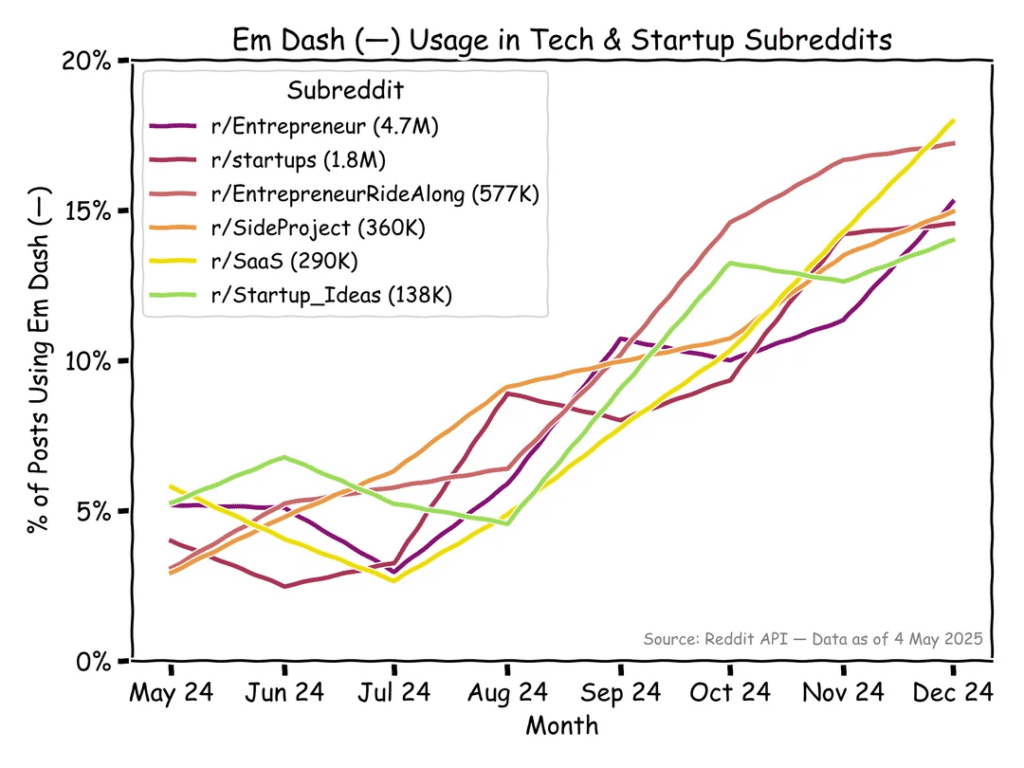
In fact, em dash usage has spiked over the last three years. Just look at this analysis from Subreddits:
2. Can’t Get Enough of Vibe and Dive
AI just loves certain words and puts them in every paragraph.
If your message includes “Let’s dive in” or “capture the right vibe,” pause.
Check out this list of common AI-generated words and phrases that can sabotage your writing. It’s a goldmine of red flags.
Sure, humans say “vibe” and “dive,” just not in every other paragraph.
3. One Declarative Statement After Another
AI loves structure.
It writes in neat little sentences. One. After. The other. Each one delivering a fact. Just like this.
There’s no variation in sentence length, no play with rhythm or flow, and it sounds like reading off a cue card.
Spice it up by adding:
- Sentence fragments. (Yes. Like this.)
- Ellipses for pause…
- Or one good run-on if it mirrors your tone.
4. Overexplains When It Doesn’t Have To
While humans assume a little and read between the lines, AI, well, not so much. It wants to be helpful, so it overexplains everything.
Example:
“A laptop is a portable computer that can be used for work, communication, and entertainment on the go.”
We know what a laptop is, thanks.
If your message is defining basic stuff like you’re talking to a time traveler from 1823, that’s AI. Trim it. Trust your reader.
5. Opens with the Cookie-Cutter “Have You Ever”
Cue the AI-generated blog post intro:
“Have you ever wondered how to increase productivity while maintaining a work-life balance?”
Yes. And no. And also yawn.
It’s the AI version of small talk. Generic, predictable, and instantly forgettable.
Human writing often draws on real stories, memories, or specific situations. Plus, you don’t need a question to hook your reader. You need a reason to make them stay.
6. Formulaic Sentence Structures
Usually, AI makes use of the same formula to create sentences. They are grammatically flawless but have a repetitive rhythm. That is because AI uses the same template every time.
Here’s how it often goes:
- Statement
- Explanation
- Supporting example
- Summary sentence
Repeat x10.
Every paragraph is shaped like the one before. To avoid this and sound human, you need to break the pattern, vary the structure, and create interruptions. That’s what real people do!
7. Tone and Style Shifts
In one paragraph, the AI’s chipper. Then, it’s weirdly formal.
Like this:
“Let’s dive into the benefits!”
“Moreover, these advantages are integral to long-term operational success.”
Wait. Are we at a pool party or a board meeting?
Tone whiplash happens when AI tries to blend styles or when it isn’t trained to match your brand voice.
Pro tip: Read your piece out loud. If it sounds like two different people wrote it, it’s time for a rewrite.
8. No Personality and Lacks Creativity
AI can write, but it can’t feel. Here’s a quick test: Does the message sound like something only you could have written?
If not, rewrite it. How? You can start by adding something personal, like a weird analogy, a specific memory, a client, or a favorite snack. Whatever it is, always remember humans leave traces of themselves in their writing, while AI leaves clean, shiny fingerprints but no soul.
9. Inaccurate Sources
Sometimes, you ask AI for a source and get this:
“According to www.technologytrendsnews.info, the rise of remote work is significant.”
Surprise! The link above doesn’t exist (well, as of this writing).
Sometimes, AI cites a random blog. Sometimes, it just makes up the URL entirely. So, always double-check your citations and verify the quotes through Google.
Spot It, Fix It, and Make It Yours
AI is an amazing tool, but it’s not a replacement for you. As a writer, you bring the context and the creativity.
Remember, there are plenty of tools out there that can help you humanize your AI text and keep your voice front and center while leveraging technological advancements.