

Have a story idea in mind, but don’t know how to put it into a structured narrative? A 5-point story structure might be just what you need. This guide will show you how it works and if it’s the right choice for your story.
What Is the 5-Point Plot Structure in Writing?
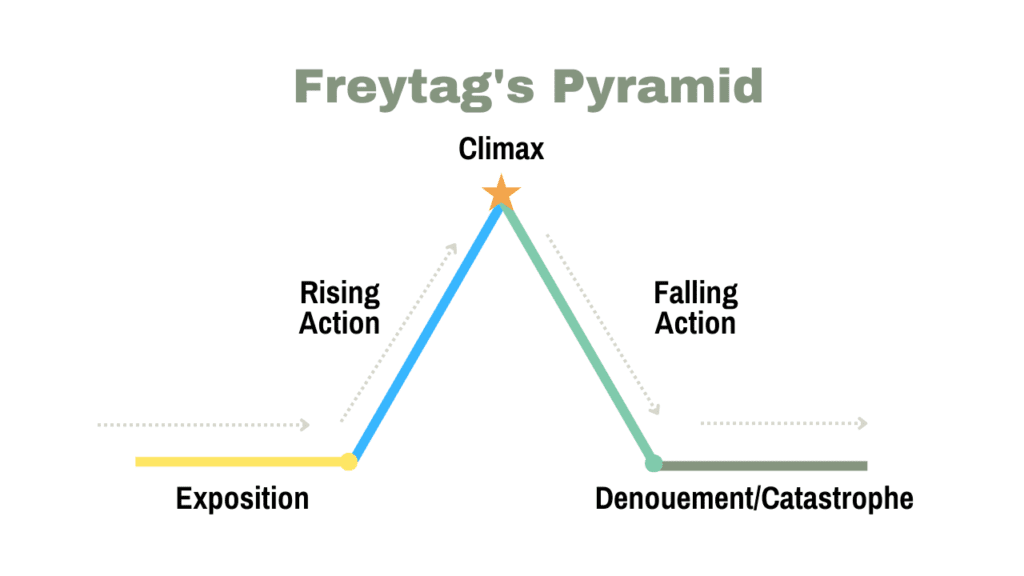
The 5-point plot structure, also known as Freytag’s Pyramid, is a storytelling framework developed by 19th-century German novelist Gustav Freytag. As its name suggests, it has five distinct points:
- Exposition
- Rising Action
- Climax
- Falling Action
- Denouement (or Catastrophe in tragedies)
When put together, the points or parts form a pyramid (more on this later!)
5-Act Structure Examples
Let’s look at this structure using some well-known stories.
The Lion King
A meeting of Disney and Shakespeare, it’s essentially Hamlet with fur.
- Act 1: Exposition: Simba is born, and Scar’s jealousy festers.
- Act 2: Rising Action: Simba grows up. Mufasa dies. Scar takes over the Pride Lands.
- Act 3: Climax – Simba encounters Rafiki and the spirit of Mufasa, which leads him to reclaim his identity and return home.
- Act IV: Falling Action: The final battle for Pride Rock begins.
- Act V: Denouement: Scar is defeated, Simba becomes king, and order is restored.
The Great Gatsby
- Act 1: Exposition: Nick meets Gatsby and gets pulled into his opulent, mysterious world.
- Act 2: Rising Action: Gatsby throws extravagant parties, and Daisy reenters his life, sparking a rekindled romance.
- Act 3: Climax: The explosive confrontation at the Plaza Hotel, where Gatsby’s dream unravels.
- Act IV: Falling Action: Myrtle dies. Gatsby waits desperately for Daisy’s call, taking the blame for her.
- Act V: Catastrophe: Gatsby dies, shot by George Wilson, and virtually no one attends his funeral.
What Makes a 5-Point Plot Structure Different from a Three-Act Structure?
As you might have already guessed, the most apparent difference between a 5-point plot structure and a three-act structure is the number of acts in the framework – the 5-point has five, whereas the three-act, well, has three.
But there’s more to consider. Here’s a closer look:
Traditional Three-Act Structure:
- Climax Placement: The climax typically occurs later in the story, usually toward the end of Act II or early in Act III. It’s often the story’s most explosive or emotionally intense moment.
- Rising Action Length: Most of the story (Act II) is dedicated to building tension, deepening conflict, and raising stakes. The protagonist often spends this time facing setbacks and making incremental progress (or mistakes).
Five-Point Plot Structure:
- Climax Placement: The major turning point (the climax) happens around the middle of the story. Keep in mind that in a five-point plot structure’s climax, it isn’t always the most action-packed moment, but rather a shift in the story’s direction.
- Rising Action Length: Since the climax is in the middle, the rising action is typically more compact compared to the extended Act II of the three-act structure. It leads up to that central shift, after which the story begins to unravel toward resolution or catastrophe.
What Are the Elements of a Five-Point Plot Structure?
We’ve mentioned earlier that there are five points. Here is a closer look at each one.
Act I: Exposition
Act I, as you might have guessed, is where your story begins. You introduce readers to important background information, such as the setting and the main character.
Example: In The Hunger Games, you are introduced to Katniss and Gale and their lives in District 12.
At the end of the Exposition (before the Rising Action kicks in) is usually the inciting incident. In our example, that would be Katniss volunteering to take her sister’s place.
Act II: Rising Action
Now that you’ve laid out the background information readers need, it’s time to move on to the second act, which is also known as the Rising Action.
Remember, Act 1 ended with the inciting incident, which means there’s nowhere else to go but to stack up the tension.
Example: After taking her sister’s place in the 74th Hunger Games, Katniss must navigate training, interviews, form alliances, and, of course, eventually survive the game.
During Act II, the main character frequently grapples with conflict:
- External conflict: Something or someone outside them prevents them from achieving their goals.
- Internal conflict: The protagonist struggles with something within themselves—a desire, fear, or an aspect they can’t reconcile with their personality or path.
Let’s take a look back at our example. Katniss’ external conflict is with the other tributes, while her internal struggle is to kill or be killed.
Act III: Climax (Midpoint)
Now, we arrive at the climax — the turning point of the story. In a five-point structure, this isn’t always the most explosive scene, but rather the moment when everything changes for the protagonist.
Keep in mind that this isn’t a moment for small decisions. The protagonist is forced to make a monumental choice (typically made under extreme duress—high stakes, limited time, and intense emotional pressure) that will alter the direction of the story.
Example: Katniss decides to fully lean into the “star-crossed lovers” narrative with Peeta when the Capitol changes the rules of the games (two tributes can win together if they are from the same district).
Act IV: Falling Action/Return
The Falling Action (or “Return”) shows the immediate aftermath of the turning point and how the story’s central conflict begins to unravel.
Example: When the Capitol tries to reverse its rule change and force Katniss and Peeta to kill each other, Katniss makes a bold move: she takes out the poisonous nightlock berries and suggests a double suicide. Faced with losing both tributes—and the PR disaster that would follow—the Capitol gives in and declares them co-victors.
Sometimes, authors add a final twist or introduce a mini-crisis to maintain engagement and explore any remaining facets of the story before the conclusion.
For example, in The Hunger Games, although Katniss and Peeta survived, President Snow threatened Katniss that she would need to continue pretending to be in love with Peeta or else he would harm her family.
Act V: Denouement/Catastrophe
The Denouement serves as your story’s final, lingering note.
During this act, the “new normal” is established, showing how the world, relationships, or the protagonist’s inner life has been permanently changed.
Example: Katniss returns to District 12 haunted by her experiences and uncertain about her feelings for Peeta. She realizes life will never return to how it was — she is now both a survivor and a symbol, caught between her identity and what the Capitol expects from her. (Of course, we all know that this is not the end of Katniss’ story.)
In tragedies like Romeo and Juliet, Act V is often referred to as a Catastrophe for a reason: it typically marks the failure, downfall, or death of the protagonist or other key figures.
AI Prompt for 5-Point Plot Structure Ideas
Feeling stuck on your story? ChatGPT can help you structure your 5-point plot narrative.
I am writing a story about [insert your main story idea]. The key elements of my story are as follows:

Protagonist: [insert information about your main character]
Antagonist: [insert information about your antagonist]
Other supporting characters: [insert information about the supporting characters]
Main conflict: [insert information about your story's main conflict]
Story's Theme: [insert story's theme]
Genre: [insert what type of genre your story is]
Setting: [insert setting information]

Your task is to create a 5-point plot structure based on my story idea and the provided key elements.
Build Stronger Stories, One Step at a Time
And there you have it! The five-point plot is a storytelling framework that puts your story idea into a structured path. Now it’s your turn to try this narrative structure.