

If that structure grabs your attention, keep reading. We’ll break it down so you can use it to shape stronger, more satisfying stories.
What Is the Man in a Hole Story Arc?
The Man in a Hole arc is a narrative structure where the protagonist starts in decent circumstances, falls into trouble, hits rock bottom, then claws their way back up, changed for the better.
This arc was popularized by Kurt Vonnegut, an American novelist known for books like Slaughterhouse-Five and Cat’s Cradle, as well as other frameworks, such as Cinderella and Boy Meets Girl.
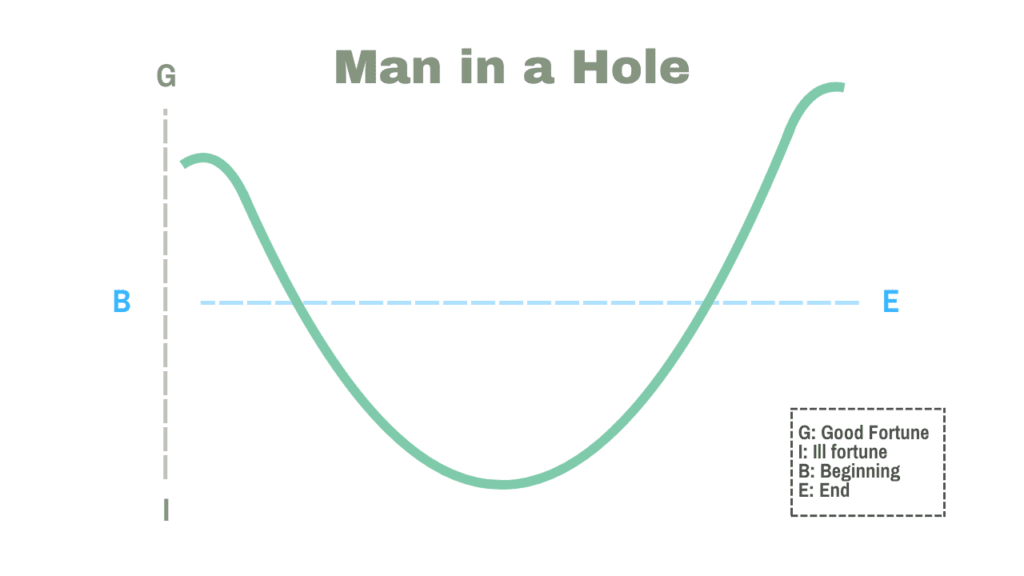
So, how does the Man in a Hole story arc work? To explain it, Vonnegut introduced the GI-axis (vertical axis) to represent the good fortune (G) and ill fortune (I) of the main character and the BE-axis (horizontal axis) for the beginning (B) and the end (E).
This narrative arc begins at the midpoint of the GI-axis, where the character starts with already good fortune (G). As the story progresses, the protagonist begins to dip and eventually reaches ill fortune (I). Eventually, though, the character rises again—back into the good fortune area (higher than the starting point, of course)—and then the story ends.
What Are the Stages of Vonnegut’s Man in a Hole Narrative?
The Man in a Hole arc follows a simple curve: up, down, then back up again. Here are the key stages.
Comfort Zone
The story begins with the character in a stable place, before things start falling apart. Sometimes the starting point feels bland. The character may not know something important is missing. But there’s balance, at least on the surface.
Basically, this is the middle point on the GI-axis. It’s not great, not terrible. Just cruising.
Trigger
This is the moment when things start to fall apart. A decision, an event, or a twist pushes the character downward.
On the GI-axis, this is where the line dips.
The trigger doesn’t have to be dramatic. It could be subtle—a letter in the mail, a lie exposed, or a missed opportunity. Whatever that trigger is, it throws the character out of balance.
Crisis
This is the lowest point. The bottom of the hole.
The character is tested—maybe they’ve lost something or someone, or perhaps they’ve hit an internal breaking point, and they can’t ignore what needs to change.
In terms of the GI-axis, they’re sitting deep in ill fortune. There’s nowhere to go but up.
Recovery
The character starts taking action: they make a choice, face the challenge, and learn something.
The story moves back upward on the GI-axis. Keep in mind that it’s not always fast, and sometimes it’s a painful recovery. But it’s still a forward motion.
This stage is what separates this arc from tragedy because there’s progress and hope.
Better Place
By the end, the character is in a stronger position than where they began, and they’ve gained something. Wisdom, strength, clarity, and sometimes, even love or justice.
On the GI-axis, this is the final peak. And it should be higher than the starting point.
Man in a Hole Examples
Here are a few stories that follow this arc and do it well.
The Martian by Andy Weir
A stranded astronaut has to find his way back to safety. It’s literally a man in a hole (Mars).
- Comfort Zone: Mark Watney is part of a functioning mission.
- Trigger: He’s left for dead during a storm.
- Crisis: He’s alone on a planet with no rescue plan.
- Recovery: He engineers ways to survive and signal Earth.
- Better Place: He’s rescued and returns home a hero.
Groundhog Day (1993)
A weatherman relives the same day over and over. It forces him to change.
- Comfort Zone: Phil Connors is smug and selfish.
- Trigger: He gets stuck in a time loop.
- Crisis: Nothing he does seems to matter.
- Recovery: He begins improving himself and helping others.
- Better Place: He wakes up changed and finally gets the girl.
Finding Nemo (2003)
A clownfish swims across the ocean to rescue his son.
- Comfort Zone: Marlin is an overprotective father.
- Trigger: Nemo gets taken by divers.
- Crisis: Marlin is lost and constantly failing.
- Recovery: He learns to trust others and let go.
- Better Place: He reunites with Nemo and grows as a parent.
ChatGPT Prompt for Man in a Hole Story Arc
Want to try if the Man in a Hole story arc is right for your story idea? Copy and paste the prompt below to ChatGPT. Don’t forget to change the placeholders!
I am writing a story about [insert topic idea]. The key elements of my story are:

Plot: [insert plot information]
Protagonist: [insert protagonist information]
Main conflict: [insert the story's main conflict]
Antagonist/Villain: [insert antagonist information]
Supporting Characters: [insert information about critical supporting characters]
Genre: [insert genre information]
Setting: [insert the story setting]

Your task is to use the information above to develop a Man in a Hole story arc. Please have the following:

- Comfort Zone
- Trigger
- Crisis
- Recovery
- Better Place
Tip: Tweak the genre, setting, or tone, and you’ll have endless versions of this arc to explore.
Digging Deeper Than the Surface
The whole premise of the Man in a Hole story arc might be simple — put the main character in a deep pit and stack ways for them to climb out. But its simplicity is what makes it work, and let’s be honest, everyone loves a good comeback story.