

Want to write poetry but don’t know where to start? The blank page can feel intimidating, but poetry doesn’t require special talent or years of study if you have a clear process to follow. These five straightforward steps will help you create poems that express what you want to say, from selecting your topic to your final draft.
Step 1. Decide on a Topic
If you rely on strategies to generate ideas, it will be easier to find your poem topic without having to wait for inspiration. Here are different approaches to discovering what you want to write about:
- Pay attention to strong emotions you’ve felt recently, whether joy, anger, grief, or confusion.
- Look for small details in your daily life that most people overlook, like shadows on a wall or the motion of the wind.
- Use the ABC brainstorm strategy to systematically work through the alphabet.
- Revisit memories that still feel vivid when you close your eyes.
- Take a current event or social issue that matters to you and find the personal angle.
- Look at objects around you and imagine their history or secret life.
- Write about a relationship that changed you, for better or worse.
Step 2. Choose a Type of Poem
Different poetry forms offer different ways express your ideas. Some have strict rules about structure, while others give you complete freedom. Here is a closer of your options:
- Haiku uses three lines of five, seven, and five syllables.
- Acrostic poems spell out a word vertically using the first letter of each line, making them perfect when you want to hide a message or name within your work.
- Limerick is a five-line form with the AABBA rhyme scheme, built for humor and wordplay.
- Elegy mourns a loss, whether of a person, place, era, or idea.
- Ballad tells a story in verse, often with repeated refrains and a song-like quality.
- Epic tackles grand subjects like wars, journeys, or the founding of nations through extended narrative.
- Free verse has no rules about rhyme, meter, or structure, giving you complete control over line breaks and rhythm.
- Ghazal consists of couplets that each stand alone while sharing a refrain and rhyme scheme.
- A sonnet has fourteen lines and follows a certain rhyme pattern. It usually presents a problem in the first eight lines and a solution in the last six lines.
- Ode celebrates its subject with elevated language and formal address.
Step 3. Consider Poetry Elements
Once you have selected a poem type, the next step is to consider integrating the following elements:
Sound
The way sound works affects how people feel about your poem, and yes, even if they’re reading it quietly.
How poets use sound:
- Hard consonants like K and T create percussive effects, while soft sounds like S and M flow more smoothly.
- Alliteration repeats initial consonants to emphasize connections between words or create musical patterns.
- Assonance repeats vowel sounds within words and builds harmonies.
- Short words and end-stopped lines create pauses.
Robert Frost uses sound masterfully in his nature poems, where the rhythm and word choice often mimic what he’s describing, like wind through trees or the crunch of snow underfoot.
Rhyme
Rhyme creates patterns that readers recognize and anticipate. You don’t need to rhyme at all, but when you do, make sure it serves your meaning —forced rhymes that twist your syntax or use weird vocabulary hurt more than they help.
Emily Dickinson often used slant rhyme (where words almost but don’t quite match, like “home” and “come”) to create unsettling effects that matched her poems’ psychological complexity.
Fun Fact: When the ends of lines match, it’s called an end rhyme, but if the rhyme occurs within the lines, you call it an internal rhyme.
Rhythm
Another element you’ll find in poems is rhythm, which you can establish by combining stressed and unstressed syllables.
Iambic pentameter, the most common meter in English poetry, follows a pattern of unstressed then stressed syllables repeated five times per line (da-DUM da-DUM da-DUM da-DUM da-DUM). Shakespeare used it because it matches natural English speech patterns while still feeling elevated.
Other ways to create rhythm:
- Repetition of phrases or structures.
- Line length: Short lines slow readers down, long lines build momentum.
- Irregular rhythm can mirror chaos or strong emotion.
- Steady rhythm suggests control or inevitability.
Literary Devices
Literary devices add depth and layer to poems, turning the simplest statements into something that sticks in readers’ minds.
- Figurative language plays with words in unusual ways to create comparisons, contrasts, or connections that help make abstract ideas clear and familiar things seem odd.
- Juxtaposition places two contrasting images, ideas, or words next to each other to highlight their differences.
- Onomatopoeia uses words that sound like what they describe, such as “buzz” or “crack,” linking the poem’s sound to its meaning.
- Simile makes clear comparisons using “like” or “as,” allowing you to see similarities between different things while keeping them distinct.
- Metaphor states that one thing is another, creating a complete identification that’s more forceful than a simile because it erases the distance between the two things being compared.
- Puns exploit multiple meanings of words or similar-sounding words to create humor.
- Chiasmus reverses the structure of phrases to create balance and emphasis.
- Imagery uses sensory details to make readers see, hear, smell, taste, or feel what you’re describing, anchoring abstract ideas in physical experience.
- Hyperbole makes things sound way more extreme than they really are, highlighting feelings instead of just the facts.
- Mood is the feeling you create in your writing with specific words, pictures, and sounds, helping readers sense the poem’s meaning even before they fully understand it.
- Motif repeats an image, phrase, or idea throughout a poem to build thematic significance and create connections between different parts.
- Personification gives human qualities to non-human things.
Step 4. Write
Get your first draft out without stopping to judge or revise. Here are more tips:
- If you get stuck, write the worst possible line you can imagine, then keep going
- Be messy, repetitive, and unclear
- Try ten different endings
- Steal your own lines from other poems
- Save everything
Step 5. Revise
Once you have the draft, it’s time to revise it:
- Cut weak or redundant lines that don’t add meaning
- Replace cliches with specific, original images
- Strengthen verbs by choosing precise words over generic ones
- Check your rhythm by reading aloud and adjusting lines that stumble
- Make imagery more sensory by adding details about how things look, sound, smell, taste, or feel
- Eliminate abstractions where concrete examples would work better
- Tighten your language by removing filler words and redundancies
- Verify your line breaks happen where you want emphasis and pauses
It’s always a good idea to wait two or three days after writing before you start revising. The distance helps you see what you actually wrote instead of what you meant to write.
Putting It All Together: Poetry AI Prompt
AI tools like ChatGPT can help you create poetry. Here’s how you can turn ChatGPT into an AI poem generator with a single prompt.
You are a poetry generator. Your task is to create a poem based on the requirements below:

Topic: [insert your preferred topic]
Poetry type: [Choose from haiku/acrostic/limerick/elegy/ballad/ epic/ghazal, sonnet/ode]
Literary device: [Choose from figurative/juxtaposition/onomatopoeia/simile/metaphor/puns/chiasmus/imgery/hyperbole/motif/personaficiation]
Rhyme: [internal/end rhyme]
Rhythm: [iambic/trochaic/spondaic/anapest/dactyl]
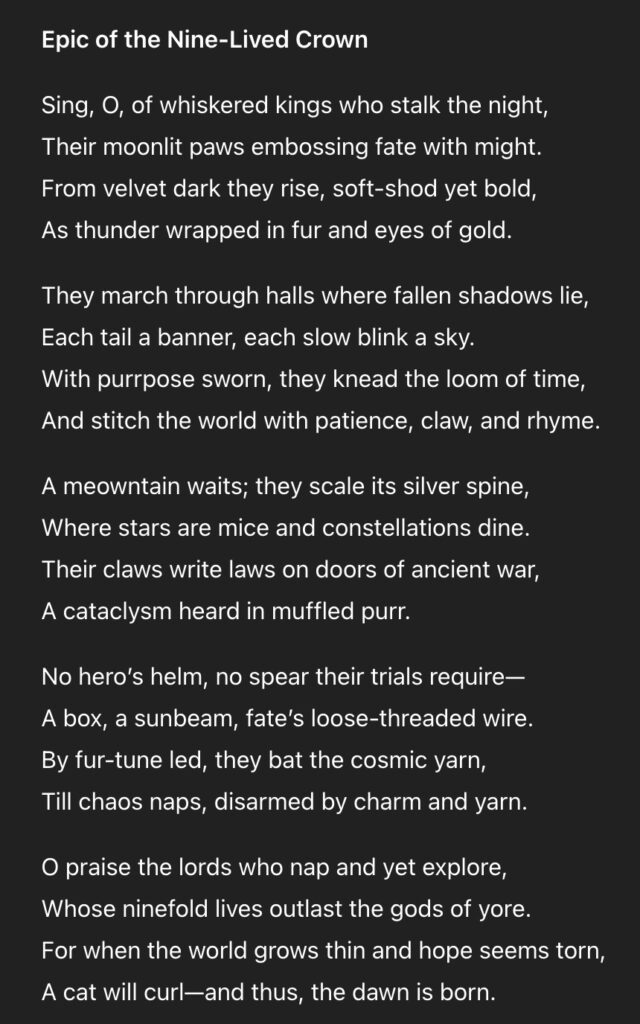
Here is an example of what you can get using the prompt above (and yes, it’s a poem about cats).
Final Thoughts
Remember, writing poetry gets easier with practice, but it always requires attention and revision. Hopefully, these five steps give you a framework to move from nothing to a finished poem with confidence. Don’t forget to try the poem maker prompt, especially when you are stuck in the dreaded writer’s block and need some inspiration.