

“Shop now.” “Learn more.” “Click here.” Sound familiar? You’ve probably come across these countless times online—they’re called calls to action, or CTAs for short. And in this article, we’ll break them down and show you how to craft one that people simply can’t resist clicking.
What Is a Call to Action?
A call to action, or CTA, is a word or phrase that tells your reader what to do next, whether that means clicking, subscribing, buying, or learning more. And, they appear anywhere —website pop-ups and banners, newsletters, blog posts, social media posts, and ads.
What Makes a Good Call to Action?
Anyone can write a CTA, but not every CTA is compelling enough for readers to take, well, the intended or specific action. A good CTA usually has the following:
- It uses strong action words that guide behavior.
- It highlights a clear benefit or outcome.
- It feels relevant to the content before it.
- It is short and concise.
- It creates motivation without pressure.
- It stands out visually and contextually.
How to Create Effective CTAs?
Now that you know what a strong CTA is, here’s how you can craft the perfect CTA to win potential customers, get higher engagement, or even boost conversions.
1. Determine Your Goal and Understand Your Target Audience
Start by defining exactly what you want your specific audience to do, and be very specific.
Are you asking them to download a guide, sign up, or explore more content? You’d better stick to one clear action, since multiple options can create friction and reduce conversions.
Then, shift the focus to your audience’s desire. Ask yourself: What problem are they actually trying to solve right now? Why would they even consider your offer?
Tip: Align your CTA with the target audience’s current stage in the journey.
2. Select a CTA Type
There are different CTAs, and they don’t all work the same. The type you choose depends on your goal and, of course, your target audience’s desires. Here are your options:
- Direct Action CTAs: This CTA is unambiguous, firm, and conversion-focused. They are typically located next to the persuasive content at the end. For instance, “Purchase now to guarantee your access.”
- Informational CTAs: This CTA is recommended if you are still establishing trust with your readers. For instance, “Find out more about how it functions.”
- Social Sharing CTAs: These motivate readers to share your content on social media platforms. For instance: “Share this guide on Facebook.”
- Feedback CTAs: If you want to build a sense of community amongst your readers and get valuable feedback at the same time, feedback CTAs are perfect.
- Personalized CTAs: This CTA type often features the reader’s or subscriber’s name. It is often used in newsletters because personalization can be automated.
3. Write
The next step is, well, start writing! But how do you write the best CTA anyway? Have these in mind to make your words move your reader closer to the action.
Use Action Words
Action words create clarity and momentum. They remove hesitation and tell your reader exactly what to do next.
Examples:
- Claim
- Join
- Download
- Start
- Get
- Discover
Give An Incentive
An incentive makes your CTA more compelling by showing the value your reader gets when they take action.
Examples:
- Get your free guide.
- Claim your 20% discount.
Create a Sense of Urgency Without Being Pushy
Urgency encourages faster decisions. It works best when it feels natural and time-sensitive.
Examples:
- Limited spots available.
- Offer ends soon.
Use Pain Points
A solid CTA must connect with a problem your readers need to solve and lead to relief or improvement.
Examples:
- Fix your low conversion rates today.
- Stop wasting time on ineffective copy.
Add Numbers
Numbers make your CTA more concrete and credible. They help your reader visualize the benefit.
Examples:
- Join 10,000+ writers improving their CTAs.
- Save 30% on your first purchase.
Keep It Short
Short CTAs are easier to read and easier to act on immediately. Plus, they remove unnecessary friction.
Examples:
- Long CTA: Click here to download your free marketing guide today.
- Short CTA: Download your free guide.
Focus On the Benefits
Your CTA should make the outcome clear by stating the specific benefit the reader will gain.
Examples:
- Get better results from your writing.
- Improve your conversions today.
(Bonus) Free AI CTA Generator
AI tools like ChatGPT can generate the best CTAs in just a couple of seconds. If you want effective call-to-actions, use our call-to-action generator prompt:
You are an expert copywriter specializing in high-performing call-to-actions (CTAs).

Your task is to generate at least 10 different CTA variations based on the provided information below.

Target auduence: [Insert info]
Primary pain point: [insert info]
Journey stage: [awareness/consideration/decision]
CTA Type: [direct action/informational/social sharing/feedback]
CTA Goal/purpose: [increase clicks/sign-ups/conversion/engagement]
Optional incentive: [discount/free guide/etc]
Tone preference: [urgent/friendly/bold]


Before writing, analyze the context and apply the following best practices whenever applicable :
- Use strong action verbs (e.g., get, short, discover)
- Use persausive language
- Highlight a clear benefit or outcome
- Address the target audience's pain point
- Keep each CTA clear and easy to scan
- Clear motivation or urgency without sounding pushing
- Match the CTA to the autidence stage of awreness
- Add specificity when possible (numbers, incentives, or outcomes)

Output requirements
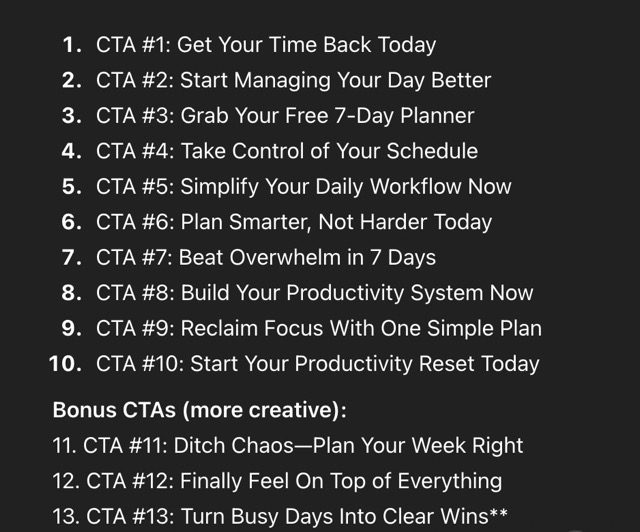
- Generate at least 10 CTA variations, with 2-3 bold or more creative bonus variations
- Each CTA should be 3–10 words max
- Each CTA must focus on ONE clear action
- Vary the structure, wording, and angle (benefit-driven, urgency-driven, curiosity-driven, etc.)
- Avoid generic phrases like “Click here” unless improved with context
- Make each variation distinct and compelling

Output format
1. CTA #1
2. CTA #2
....10. CTA#10
Here is an example output of our AI CTA generator prompt:
Final Thoughts
And there you have it. CTAs are words and phrases that direct readers (or viewers) to complete an action (that you want them to do, of course). Remember, a good CTA needs direction and purpose. It must turn your reader’s attention into an action by making the next step clear and valuable.