
Brainstorming Techniques and Tools to Get Your Creativity Flowing

Stuck in that maddening loop where you know you want to write but every idea feels bland, boring, or just off? These brainstorming techniques can help you break free of the cycle and finally get words flowing again. We’ve also tossed in a couple of helpful tools to make the whole “figuring out what to write” part less chaotic. 

7 Brainstorming Techniques

Half-formed thoughts, vague concepts, or cliché angles? You can bid them farewell with these seven brainstorming techniques. 

ABC Strategy 

If you hate complex frameworks, you’ll love the ABC strategy. What does it entail, you ask? It’s frankly quite simple: 

  1. Write down the alphabet from A to Z.
  2. For each letter, add a word or short phrase related to your idea.
  3. Skip around; fill in what comes to mind first.
  4. Review your list to spot patterns and connections.

That’s it. Feeling like this might actually be the brainstorming technique your brain has been begging for? You can learn more in our ABC brainstorm strategy guide

Cubing Brainstorming

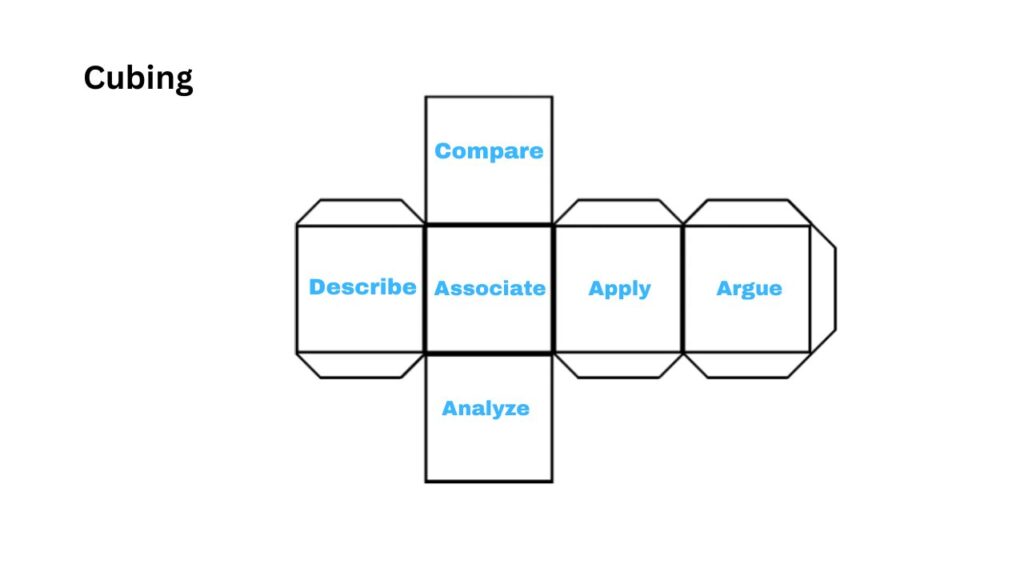
Photo showing how cubing brainstorming works

What if you already have an idea in mind, but it still feels a little flat? The cubing brainstorming technique is what you need. 

Cubing helps you poke, prod, and twist your topic from six different angles, just like the six sides of a cube, so you can dig deeper and uncover insights, and finally see what your idea is really missing. 

Here’s how it works: 

  1. Describe: Start by defining your topic in detail.
  2. Compare: Identify what it’s similar to and what sets it apart.
  3. Associate: Connect it to related ideas, experiences, or concepts.
  4. Analyze: Break it down into parts and look for causes, patterns, and other relevant details.
  5. Apply: Think about how it works in practice or where it could be used.
  6. Argue: What’s good or bad about it? Defend or challenge the idea.

The SCAMPER Method 

Photo showing the SCAMPER Method

If you are determined not to write yet another clichê story, try the SCAMPER method. It basically forces you to stop taking the obvious route by running it through different lenses. It works like this: 

  1. Substitute: Switch one element for another.
  2. Combine: Merge ideas.
  3. Adapt: Adjust an existing idea to fit a new context, trend, or audience.
  4. Modify: Change the narrative, the structure, and even the characters. 
  5. Put to another use: Find new purposes for what already exists.
  6. Eliminate: Remove what’s unnecessary or overly complex.
  7. Reverse: Flip assumptions for an unexpected plot twist

Clustering 

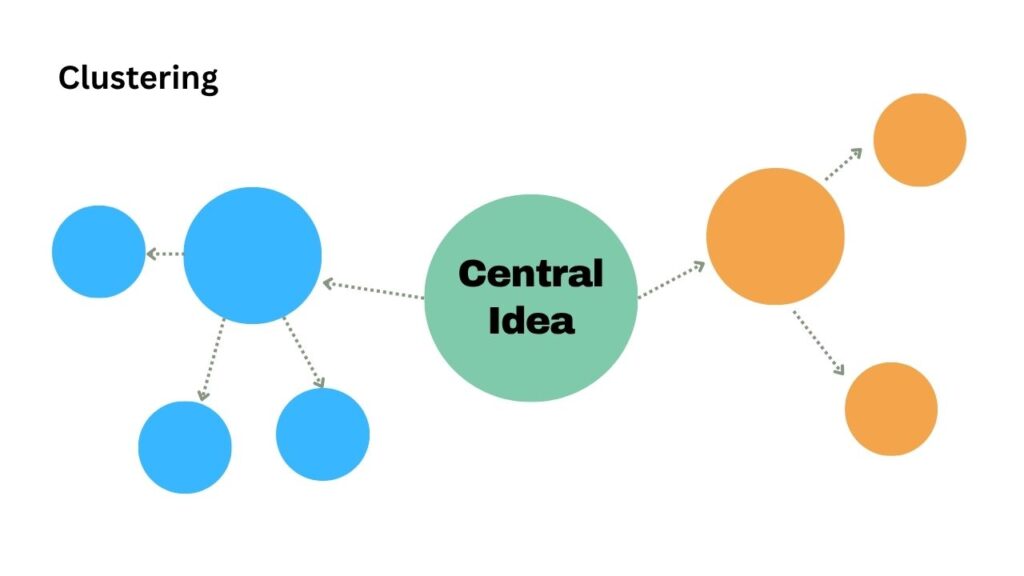
Photo showing an example of clustering

Do you prefer visual brainstorming? Clustering is like mind mapping, where you group related ideas or key themes around a central topic and see the connections between them.

Here’s how to do it step-by-step:

  1. Start with a central idea: Jot your main idea in the center of a blank page or in a digital tool like Miro
  2. Add related ideas: Draw lines out to new circles containing words or short phrases that relate to the main idea. These are your first-level clusters.
  3. Keep branching out: For each of those related ideas, think about what else connects to them. 
  4. Look for patterns: Once you’ve filled the page, take a step back and review it. You’ll notice that some clusters are richer or more developed; these often point to your strongest directions.
  5. Refine and organise: Highlight or number the most relevant clusters. These will serve as the foundation for your next stage.

Looping 
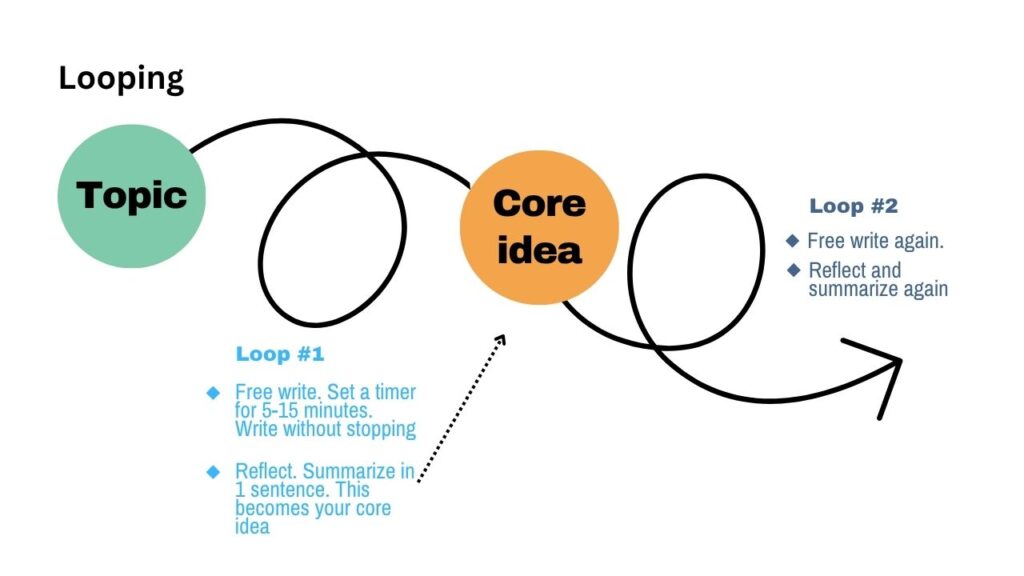
Photo showing how looping prewriting or brainstorming technique works

What if you’re unsure what you want to say yet, but you’re ready to start writing? Looping, a mix of free writing and reflection, allows you to discover your main idea through a series of “loops.” 

So, how do you loop?

  1. Choose your topic: Start with a broad idea you’d like to explore. It doesn’t need to be perfectly defined.
  2. Loop One: Free write. Set a timer for 5–15 minutes and write without stopping. 
  3. Reflect and find the core: When your timer goes off, read what you wrote. Look for the most interesting point, and summarise it in one strong sentence; this becomes your core idea.
  4. Loop Two: Write again. Start your next round of writing using that core idea as your new focus.
  5. Reflect and refine again: After each writing round, read over what you wrote, find the next key idea, and create a new summary sentence. Each reflection sharpens your direction.
  6. Repeat as needed: Continue the process; write, reflect, write again, until you feel you’ve uncovered something meaningful.
  7. Wrap it up: When you’re done, skim through all your loops. Highlight any ideas you didn’t explore that are still worth chasing.

T-Chart 
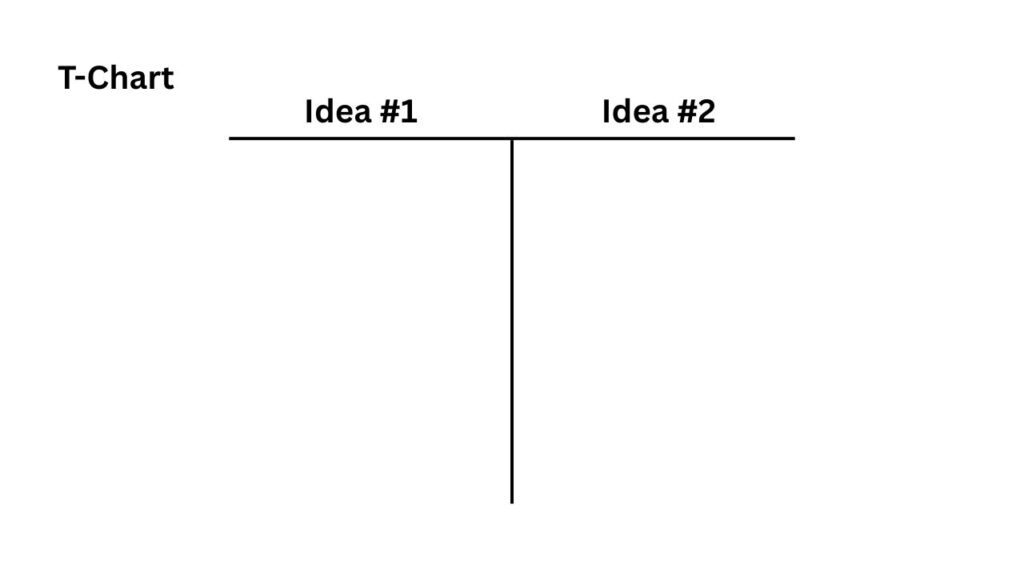
Photo showing an example of a T-chart for brainstorming

Do you have two different ideas that you’d like to compare and contrast? A T-Chart is an excellent yet simple strategy to use. It is essentially a comparison table where a line (either horizontally or vertically) separates your two ideas into their own respective columns. 

How it works:

  1. Choose your layout
    1. Vertical T-Chart: Best for comparing two items side by side.
    2. Horizontal T-Chart: Best for showing change or progression.
  2. Draw the T chart. 
  3. Label each column.
  4. Add content:  Fill in each side with details, examples, or data.
  5. Review patterns: Step back and identify contrasts, relationships, or trends.

SWOT Analysis
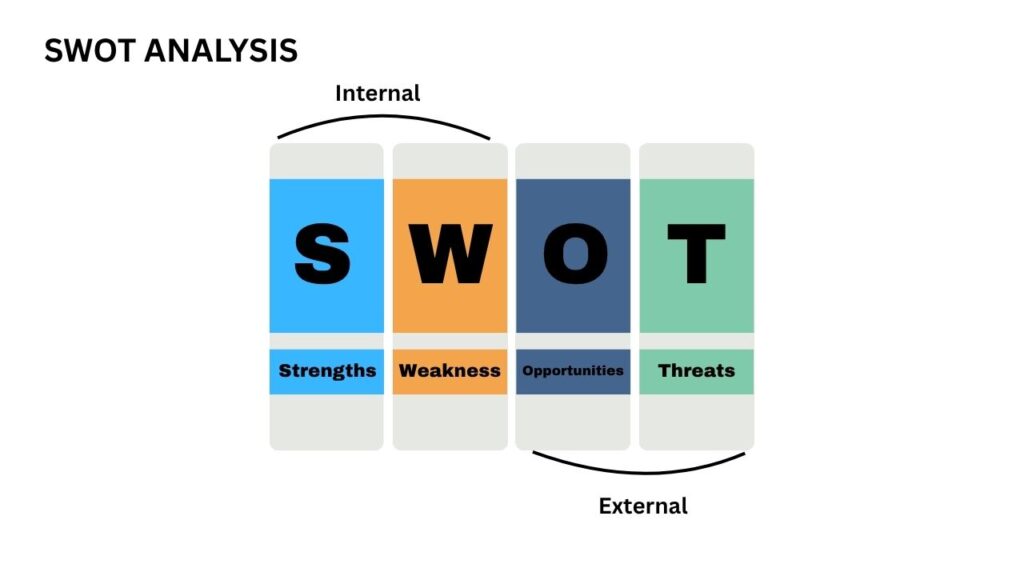
Photo showing SWOT analysis diagram

If you find the previous technique too barebones or you prefer a more comprehensive approach, you can always turn to a classic brainstorming technique: SWOT analysis, which stands for: 

  1. Strengths
  2. Weaknesses
  3. Opportunities 
  4. Threats

And, it works like this:

  • List the strengths of your idea. (For instance, not a clichê plot). 
  • Acknowledge weaknesses (ex., Characters are underdeveloped).
  • Spot opportunities for improvement. (ex., introduce a B-story plot)
  • Assess threats: Consider obstacles or risks that could limit your idea.

4 Online Brainstorming Tools

Before trying any of the brainstorming techniques, make sure you’ve got the right tools at your side. Some will help you keep your thoughts in order, while others nudge you to look at your writing from a new perspective. Here are our top picks: 

MindMeister 

Photo showing an example mind map using MindMeister

Looking for a visual mind-mapping tool that helps you explore ideas in a clear, structured way? MindMeister is definitely worth a try. 

Start with a central idea and let your imagination take it wherever it leads —you can branch out into related topics, add notes, diagrams, links, or images. When you’re done, you can export your mind map. And if you are working with other writers? Good news, MindMeister updates in real-time, allowing teams to brainstorm together seamlessly. 

Notion 

Photo showing an example dashboard of Notion

Tired of juggling ten different apps while trying to write? Notion works like a digital notebook. You can dump every idea, outline, and even half-formed thoughts, and, yes, while still keeping everything organized. 

What’s more, you can create templates, jot down open-ended ideas, and structure them into lists or boards. Its AI-powered features can generate suggestions or summarise your notes, helping jump-start creativity when you feel stuck. 

XMind 
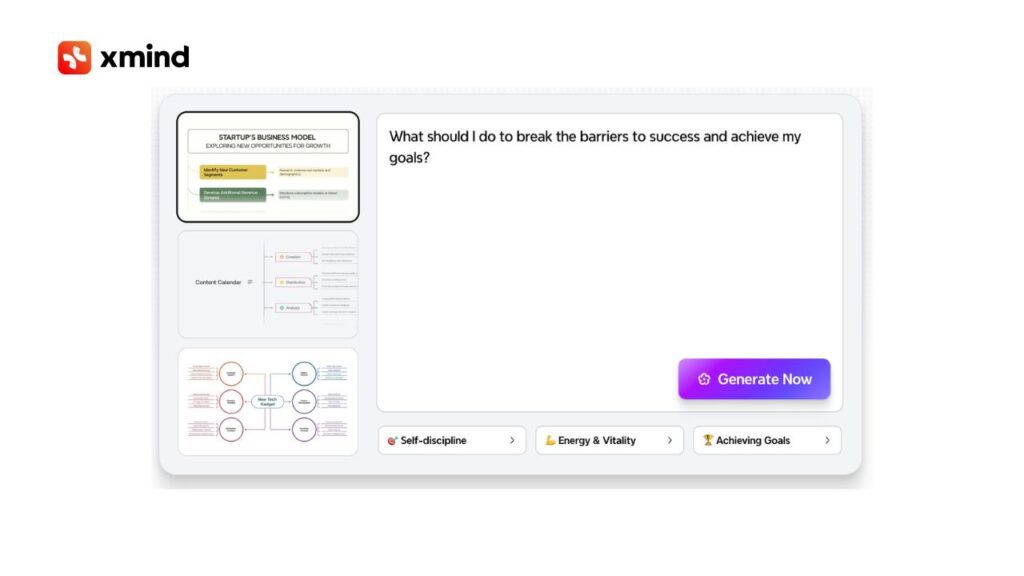
Photo showing how XMind works

Got a lot of tangled, complex ideas that need sorting out. Try XMind. It lets you choose from multiple layouts, so you can map everything out in a way that actually makes sense. This, in turn, allows you to spot patterns, fill gaps, and even connect ideas that you may have missed. Another perk? XMind keeps everything in sync, whether you’re switching between devices or working with a writing partner. 

Scrivener
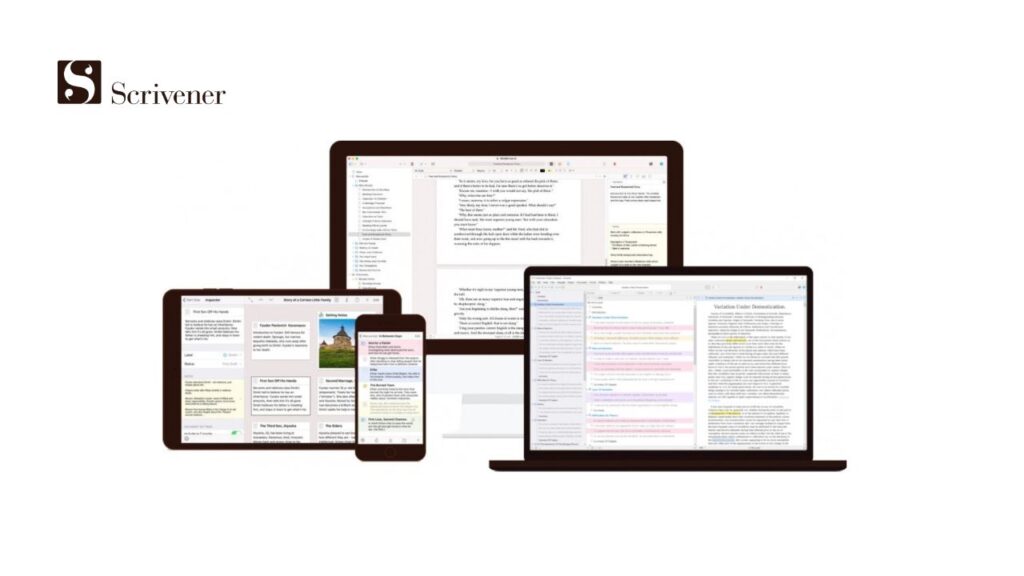
Photo showing how Scrivener works

Scrivener is primarily designed for long-form writing, but it also serves as a fantastic place to brainstorm. You can collect research, notes, and partial ideas all in one project, then rearrange sections freely to explore different directions. For writers, it’s particularly useful because it integrates brainstorming directly into the drafting process.

ChatGPT and Other AI Tools

And, of course, there are AI tools like ChatGPT, which provide a flexible and fast way to spark new ideas. You can throw in a question, a half-baked concept, or even a random scenario, and the AI will fire back with different suggestions in a matter of seconds. Of course, you will need the right prompt to get better results. 

Here’s a simple prompt that you could use for your next brainstorming session: 

I want to write about [insert your idea], but I'm uncertain about the direction of the story. Please brainstorm and provide suggestions. 

Final Thoughts

Stop waiting for the next big idea to hit you miraculously. As you can see, there are a handful of brainstorming techniques and tools right at your fingertips. And, if any of them have sparked something, let us know in the comments!

Brainstorming Techniques and Tools to Get Your Creativity Flowing

Stuck in that maddening loop where you know you want to write but every idea feels bland, boring, or just off? These brainstorming techniques can help you break free of the cycle and finally get words flowing again. We’ve also tossed in a couple of helpful tools to make the whole “figuring out what to write” part less chaotic. 

7 Brainstorming Techniques

Half-formed thoughts, vague concepts, or cliché angles? You can bid them farewell with these seven brainstorming techniques. 

ABC Strategy 

If you hate complex frameworks, you’ll love the ABC strategy. What does it entail, you ask? It’s frankly quite simple: 

  1. Write down the alphabet from A to Z.
  2. For each letter, add a word or short phrase related to your idea.
  3. Skip around; fill in what comes to mind first.
  4. Review your list to spot patterns and connections.

That’s it. Feeling like this might actually be the brainstorming technique your brain has been begging for? You can learn more in our ABC brainstorm strategy guide

Cubing Brainstorming

Photo showing how cubing brainstorming works

What if you already have an idea in mind, but it still feels a little flat? The cubing brainstorming technique is what you need. 

Cubing helps you poke, prod, and twist your topic from six different angles, just like the six sides of a cube, so you can dig deeper and uncover insights, and finally see what your idea is really missing. 

Here’s how it works: 

  1. Describe: Start by defining your topic in detail.
  2. Compare: Identify what it’s similar to and what sets it apart.
  3. Associate: Connect it to related ideas, experiences, or concepts.
  4. Analyze: Break it down into parts and look for causes, patterns, and other relevant details.
  5. Apply: Think about how it works in practice or where it could be used.
  6. Argue: What’s good or bad about it? Defend or challenge the idea.

The SCAMPER Method 

Photo showing the SCAMPER Method

If you are determined not to write yet another clichê story, try the SCAMPER method. It basically forces you to stop taking the obvious route by running it through different lenses. It works like this: 

  1. Substitute: Switch one element for another.
  2. Combine: Merge ideas.
  3. Adapt: Adjust an existing idea to fit a new context, trend, or audience.
  4. Modify: Change the narrative, the structure, and even the characters. 
  5. Put to another use: Find new purposes for what already exists.
  6. Eliminate: Remove what’s unnecessary or overly complex.
  7. Reverse: Flip assumptions for an unexpected plot twist

Clustering 

Photo showing an example of clustering

Do you prefer visual brainstorming? Clustering is like mind mapping, where you group related ideas or key themes around a central topic and see the connections between them.

Here’s how to do it step-by-step:

  1. Start with a central idea: Jot your main idea in the center of a blank page or in a digital tool like Miro
  2. Add related ideas: Draw lines out to new circles containing words or short phrases that relate to the main idea. These are your first-level clusters.
  3. Keep branching out: For each of those related ideas, think about what else connects to them. 
  4. Look for patterns: Once you’ve filled the page, take a step back and review it. You’ll notice that some clusters are richer or more developed; these often point to your strongest directions.
  5. Refine and organise: Highlight or number the most relevant clusters. These will serve as the foundation for your next stage.

Looping 

Photo showing how looping prewriting or brainstorming technique works

What if you’re unsure what you want to say yet, but you’re ready to start writing? Looping, a mix of free writing and reflection, allows you to discover your main idea through a series of “loops.” 

So, how do you loop?

  1. Choose your topic: Start with a broad idea you’d like to explore. It doesn’t need to be perfectly defined.
  2. Loop One: Free write. Set a timer for 5–15 minutes and write without stopping. 
  3. Reflect and find the core: When your timer goes off, read what you wrote. Look for the most interesting point, and summarise it in one strong sentence; this becomes your core idea.
  4. Loop Two: Write again. Start your next round of writing using that core idea as your new focus.
  5. Reflect and refine again: After each writing round, read over what you wrote, find the next key idea, and create a new summary sentence. Each reflection sharpens your direction.
  6. Repeat as needed: Continue the process; write, reflect, write again, until you feel you’ve uncovered something meaningful.
  7. Wrap it up: When you’re done, skim through all your loops. Highlight any ideas you didn’t explore that are still worth chasing.

T-Chart 

Photo showing an example of a T-chart for brainstorming

Do you have two different ideas that you’d like to compare and contrast? A T-Chart is an excellent yet simple strategy to use. It is essentially a comparison table where a line (either horizontally or vertically) separates your two ideas into their own respective columns. 

How it works:

  1. Choose your layout
    1. Vertical T-Chart: Best for comparing two items side by side.
    2. Horizontal T-Chart: Best for showing change or progression.
  2. Draw the T chart. 
  3. Label each column.
  4. Add content:  Fill in each side with details, examples, or data.
  5. Review patterns: Step back and identify contrasts, relationships, or trends.

SWOT Analysis

Photo showing SWOT analysis diagram

If you find the previous technique too barebones or you prefer a more comprehensive approach, you can always turn to a classic brainstorming technique: SWOT analysis, which stands for: 

  1. Strengths
  2. Weaknesses
  3. Opportunities 
  4. Threats

And, it works like this:

  • List the strengths of your idea. (For instance, not a clichê plot). 
  • Acknowledge weaknesses (ex., Characters are underdeveloped).
  • Spot opportunities for improvement. (ex., introduce a B-story plot)
  • Assess threats: Consider obstacles or risks that could limit your idea.

4 Online Brainstorming Tools

Before trying any of the brainstorming techniques, make sure you’ve got the right tools at your side. Some will help you keep your thoughts in order, while others nudge you to look at your writing from a new perspective. Here are our top picks: 

MindMeister 

Photo showing an example mind map using MindMeister

Looking for a visual mind-mapping tool that helps you explore ideas in a clear, structured way? MindMeister is definitely worth a try. 

Start with a central idea and let your imagination take it wherever it leads —you can branch out into related topics, add notes, diagrams, links, or images. When you’re done, you can export your mind map. And if you are working with other writers? Good news, MindMeister updates in real-time, allowing teams to brainstorm together seamlessly. 

Notion 

Photo showing an example dashboard of Notion

Tired of juggling ten different apps while trying to write? Notion works like a digital notebook. You can dump every idea, outline, and even half-formed thoughts, and, yes, while still keeping everything organized. 

What’s more, you can create templates, jot down open-ended ideas, and structure them into lists or boards. Its AI-powered features can generate suggestions or summarise your notes, helping jump-start creativity when you feel stuck. 

XMind 

Photo showing how XMind works

Got a lot of tangled, complex ideas that need sorting out. Try XMind. It lets you choose from multiple layouts, so you can map everything out in a way that actually makes sense. This, in turn, allows you to spot patterns, fill gaps, and even connect ideas that you may have missed. Another perk? XMind keeps everything in sync, whether you’re switching between devices or working with a writing partner. 

Scrivener

Photo showing how Scrivener works

Scrivener is primarily designed for long-form writing, but it also serves as a fantastic place to brainstorm. You can collect research, notes, and partial ideas all in one project, then rearrange sections freely to explore different directions. For writers, it’s particularly useful because it integrates brainstorming directly into the drafting process.

ChatGPT and Other AI Tools

And, of course, there are AI tools like ChatGPT, which provide a flexible and fast way to spark new ideas. You can throw in a question, a half-baked concept, or even a random scenario, and the AI will fire back with different suggestions in a matter of seconds. Of course, you will need the right prompt to get better results. 

Here’s a simple prompt that you could use for your next brainstorming session: 

I want to write about [insert your idea], but I'm uncertain about the direction of the story. Please brainstorm and provide suggestions. 

Final Thoughts

Stop waiting for the next big idea to hit you miraculously. As you can see, there are a handful of brainstorming techniques and tools right at your fingertips. And, if any of them have sparked something, let us know in the comments!