

Most first drafts lose momentum somewhere in the middle, leaving characters and the entire story wandering without a clear direction. Luckily, with the 9 Point Story Structure, you’ll know exactly what needs to happen in every chapter, so you’ll have consistent pacing and development from start to finish.
What Is the 9 Point Story Structure?

The 9 Point Story Structure, also known as the 27 Chapter Method or 3 Act 9 Block 27 Chapter Method, divides your novel into three acts, which are further subdivided into nine blocks of three chapters each.
While it shares the basic three-act structure common to many narrative frameworks like the Hero’s Journey and Save the Cat Beat Sheet, the 27 Chapter Method, which was introduced by writer Kat O’Keefe, distinguishes itself through its granular approach. Rather than providing vague guidance about beginning, middle, and end, it specifies exactly what should occur in each chapter.
How to Use the 27-Chapter Method?
Want to try the 27-chapter method for your next story? Here’s exactly what happens in each act and its respective blocks.
Act 1: Setup

In Act 1, your goal is to present your character’s ordinary world, disrupt it with a compelling inciting incident, and show the immediate consequences that force your protagonist onto their journey.
Block 1

Chapter 1: Introduction
Chapter 1 is about establishing who your protagonist is and what their normal life looks like before everything changes. Of course, this chapter should also hint at their internal flaw or limitation, which they will need to overcome.
Tip: These early pages set the baseline against which all future changes will be measured, so choose details that will become significant later in your narrative.
Chapter 2: Inciting Incident
The inciting incident disrupts your protagonist’s ordinary world and introduces the central story question that your novel will spend the rest of its pages answering.
In Harry Potter and the Philosopher’s Stone, the inciting incident occurs when Hagrid arrives to tell Harry he’s a wizard and has been accepted to Hogwarts. This revelation fundamentally changes everything Harry believed about himself and his place in the world.
Tip: Your inciting incident shouldn’t be just a minor inconvenience to your protagonist. It should turn their world upside down.
Chapter 3: Immediate Fallout
This is your protagonist’s first emotional reckoning with what’s changed. Does your protagonist immediately leap into action, or do they try to avoid the problem? Their response here establishes patterns that will be tested and transformed throughout the narrative.
Block 2

Chapter 4: Reaction
In this chapter, your protagonist makes their first active response to the situation created by the inciting incident. They might gather information, seek advice, or attempt a preliminary solution based on their existing knowledge and skills. This reaction reflects their current limitations rather than the wisdom they’ll gain through their journey.
Tip: The action here often fails, proving that your protagonist needs to grow beyond their current capabilities to succeed.
Chapter 5: Action
This chapter shows your protagonist engaging with the central conflict rather than avoiding it. They take more decisive action based on what they learned from their initial reaction, and set their journey in motion –even if they don’t yet fully understand where that will lead them.
Chapter 6: Consequence
The actions your protagonist took in Chapter 5 produce results that change their situation for better or worse. These consequences raise the stakes and typically reveal that the problem is more complex than your character initially understood.
Block 3
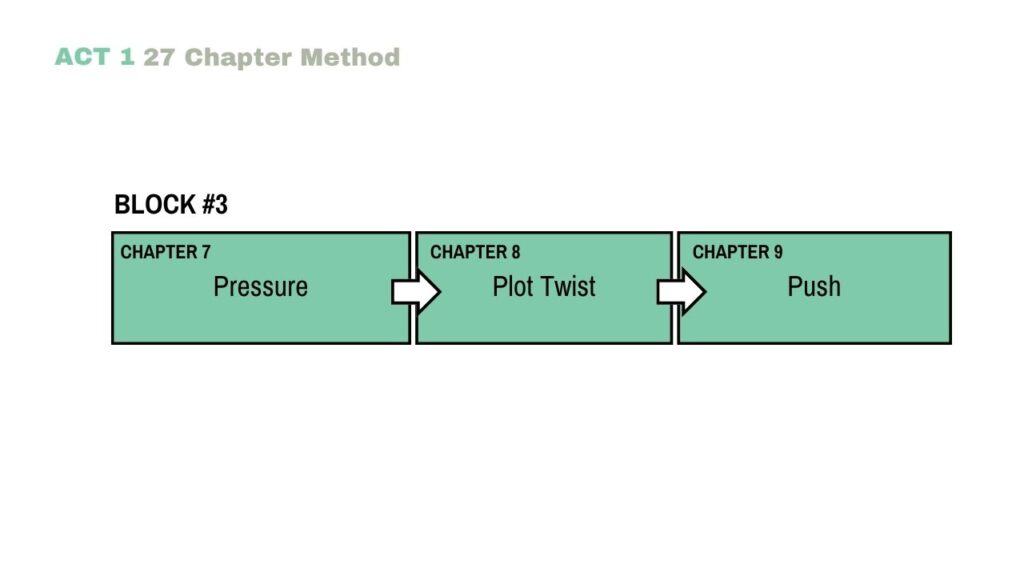
Chapter 7: Pressure
In this chapter, outside forces become more intense, creating pressure that keeps your protagonist from walking away from the confrontation. There is an urgency created by other characters, situations, or deadlines that call for ongoing participation. This increasing pressure frequently comes from several sources at once, forcing your character to take action.
Chapter 8: Plot Twist
This chapter changes the protagonist’s entire perception of their circumstances. The twist may involve uncovering that a supposed ally is actually an adversary, gaining insight into hidden aspects of the main conflict, or realizing that the issue is much broader than initially apparent.
Tip: Your twist should force both protagonist and reader to reconsider their beliefs while raising the stakes for what follows.
Chapter 9: Push
Chapter 9 is the transition from Act 1 to Act 2.
The twist in Chapter 8 drives your protagonist beyond a threshold into a different phase of their journey. They leave the comforts of their familiar world and venture into uncharted territory, either literally or figuratively. Given everything that has happened, this push should appear inevitable but still have meaning and weight.
Act 2: Conflict

The second act places your protagonist at the heart of the main conflict. It has the most pronounced variations in your protagonist’s arc, going from apparent victories to significant obstacles as they work towards their goals.
Block 4

Chapter 10: New World
This chapter sets the stage for the environment where much of the story will take place.
The protagonist navigates the new world or situation. They often find themselves in challenging positions, which open up avenues for growth and errors that will propel the plot.
Chapter 11: Fun & Games
While serious obstacles still exist, this chapter allows some breathing room to enjoy the journey. For instance, if you’re writing a heist novel, this is where you show the team assembling. Or, if your story involves a magical school, this is where you explore classes and spell-learning.
Chapter 12: Old World Juxtaposition
In this chapter, your protagonist encounters a situation that brings back memories of their past. A visit from their past, a task that would have been easy with their previous abilities, or a flashback to simpler times could all be examples of this juxtaposition.
Block 5

Chapter 13: Build-up
A string of successes leads to the suggestion that the protagonist might actually triumph. This could be relationships that deepen, skills that improve, or obstacles that appear manageable.
Chapter 14: Midpoint
The midpoint represents a big shift in your story, often involving a significant victory or revelation that appears to resolve the central conflict or fundamentally change your protagonist’s understanding of their situation.
For instance, in Pride and Prejudice, the midpoint occurs when Elizabeth reads Darcy’s letter explaining Wickham’s role in saving Lydia. The revelation leads Elizabeth to rethink everything she had previously thought about both men.
Chapter 15: Reversal
The consequences of the midpoint reveal themselves, and what seemed like success was actually a setup for a greater fall. In The Empire Strikes Back, for instance, the reversal occurs when Darth Vader reveals he is Luke’s father.
Something to keep in mind: This chapter initiates the downward movement that will continue through the rest of Act 2, stripping away your protagonist’s confidence and resources as they approach their lowest point.
Block 6

Chapter 16: Reaction
The protagonist reacts to the reversal with shock, denial, or grief. And the confidence that they developed in Chapters 13-14? Well, it disappears as they face the extent of their challenge.
This response reveals character depth and shows how the protagonist copes with significant setbacks. Some characters may express anger towards allies, while others may shut down.
Tip: These emotional reactions should always be in character.
Chapter 17: Trials
Chapter 17 is a character-revealing stage. Your protagonist faces a series of increasingly difficult obstacles that test them physically, emotionally, or morally.
Tip: Write scenes that strip away your protagonist’s external resources, forcing them to rely on internal qualities.
Chapter 18: Dedication
In this chapter, you tell why the protagonist chooses tо gо on, even when there are logical reasons tо give up. The reasons should be linked to their values or their connections with others.
Act 3: Resolution

Act 3 brings your narrative threads together, testing everything your protagonist has learned and resolving the central conflicts you’ve developed.
Something to keep in mind: These final nine chapters must deliver emotional satisfaction and maintain tension all the way to the end.
Block 7

Chapter 19: Calm Before the Storm
Before the final battle, there іs a brief respite. This could be a planning session, a time for introspection, or a discussion to clarify motivations. This pause is critical because it will remind the readers оf the stakes.
Chapter 20: Plot Twist
A significant plot twist changes the protagonist’s understanding оf the central conflict.
It’s not the same plot twist in Act I, though. Known as “pinch two,” this unexpected event strips the character of any remaining advantages and leads them to their lowest point.
It should feel both surprising and, in hindsight, inevitable, potentially involving betrayal from an ally, the unveiling of a hidden enemy, or the realization that the protagonist’s solution is flawed.
Chapter 21: Darkest Moment
The protagonist hits rock bottom. Allies may have deserted them, and their goal seems unattainable, creating a bleak atmosphere that makes readers doubt their chances оf success.
Tip: This chapter should emphasize the character’s external struggles and internal despair, which, in return, adds emotional depth tо the story.
Block 8
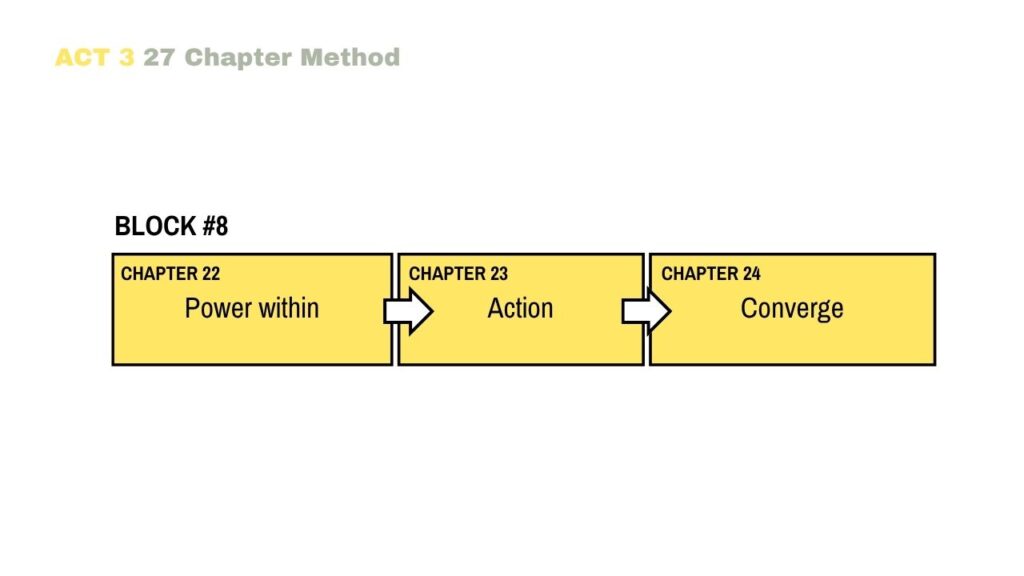
Chapter 22: Power Within
This chapter represents the culmination оf your character’s arc, showing how their journey has transformed them into someone capable оf succeeding where they would have failed before.
The power within isn’t typically a new external tool оr ally but rather a realization, acceptance оf a difficult truth, оr embrace оf a quality they’d previously rejected.
Chapter 23: Action
With a newfound strength and understanding to take decisive action, the protagonist implements a new strategy that reflects their growth. This action marks a turning point in the story.
Chapter 24: Converge
Groundwork is needed (allies collaborate and plans align) before the final showdown. So, use this chapter to generate momentum and anticipation while showcasing how subplots relate to the central conflict.
Block 9

Chapter 25: Final Battle
This is when your protagonist faces their ultimate challenge. They utilize both the external skills they’ve gained and the internal transformation they’ve undergone.
Tip: The stakes at this point must feel fittingly dramatic and in line with the journey the reader has witnessed so far.
Chapter 26: Climax
The climax is the moment when your central story question receives its answer and delivers the emotional and narrative payoff. Of course, this chapter should also show how the protagonist’s internal change enables them to face the decisive challenge.
Chapter 27: Resolution
The final chapter is the aftermath of the climax, which often reveals the growth and new normal of the main character. This chapter also ties all loose ends (unless you want the ending to be open-ended, of course).
Try the 9 Point Story Structure With this AI Prompt
Want to test if the 27-chapter method is right for your story? Enter this AI prompt in ChatGPT:
I am writing a story about [insert the story's plot]. I want you to develop an outline, using the 27 Chapter Method. The 27 Chapter Method consists of the following:

ACT I
- Intro
- Inciting Incident
- Immediate Reaction
- Reaction
- Action
- Consequence
- Pressure
- Pinch
- Push

ACT II
- New World
- Fun & Games
- Old Contrast
- Build Up
- Midpoint
- Reversal
- Consequence
- Trials
- Dedication

ACT III
- Calm Before The Storm
- Pinch
- Darkest Point
- Power Within
- Action
- Converge
- Battle
- Climax
- Resolution
Final Thoughts
And there you have it! If you are struggling to build and maintain momentum in your story, the 9 Point Story Structure or 27 Chapter Method might be just what you need!