

Congratulations! You just finished your book. But how about the description? Yes, you have to write that too. Why? That’s what draws readers in and, to be honest, gets them to buy your book.
If it’s your first time writing one, it can be tricky. Do you tell the entire plot, or just enough for readers to get the premise—but not enough to spoil the story? (Hint: it’s the latter.) That’s where this guide comes in. Here’s everything you need to know about writing book descriptions that sell.
What Is a Book Description and What Is It For?
A book description provides an overview of the story. It’s concise and has enough key details and mystery to make potential readers care and be intrigued.
So, is it the same as a book blurb? Book descriptions and blurbs are often used interchangeably, but they are not technically the same.
A book blurb is essentially a short marketing copy (usually less than 200 words) meant to hook readers in. It doesn’t say much about the plot or the characters.
On the other hand, a book description is more in-depth but provides enough details to pique readers’ curiosity. It could be the main conflict, the setting, the main character, or a combination of the three.
Let’s take a closer look. Here’s the book description and book blurb of Suzanne Collins’ Sunrise On the Reaping:
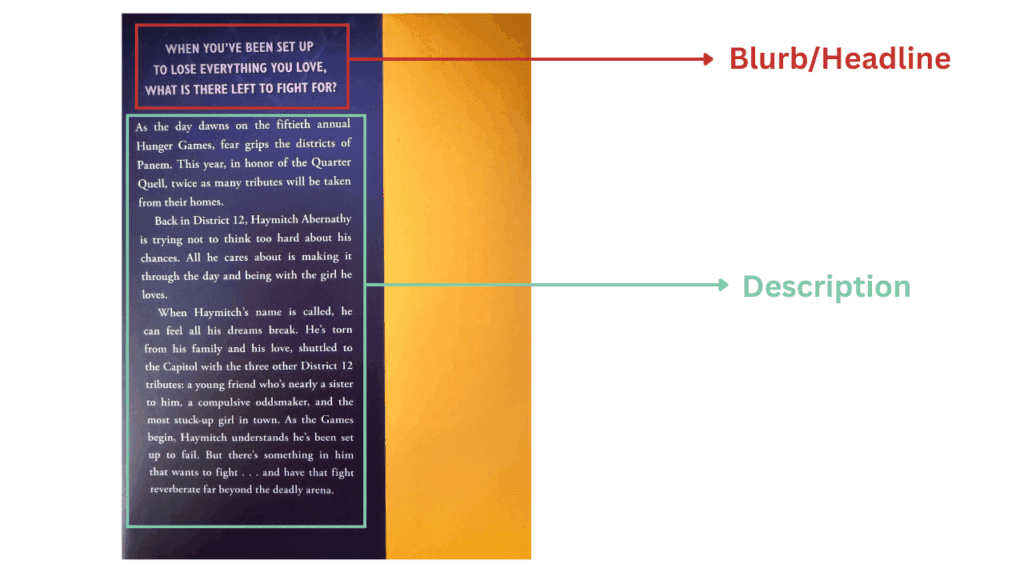
And yes, a book blurb and a book description can appear together.
How to Write a Good Book Description
Now that we’ve cleared what a book description is, and its difference to a book blurb, here is a simple step-by-step guide on how to write one.
1. Start With the Headline
Your headline is the first line of the book description, and it’s meant to be attention-grabbing so potential readers are encouraged to read or scan the description.
So, what should you have for the headline? Well, it should be less about the specific details of your book! Remember that information should go in the main body of the description.
Here are some ideas for your headline:
- A provocative statement
- A question
- A preview of the plot
Tip: Make sure your headline is relevant and coherent, and use sensory words.
Here are some examples:
- “A reluctant hero. A forbidden power. A choice that could destroy everything.”
- “She ran from the truth. Now it’s hunting her.”
- “The system isn’t broken; your strategy is.”
- “Everything you think you know about success is outdated.”
A book headline is about 200 characters max. And yes, it can be just one sentence long.
Is a headline required? Technically, no. But a headline can make a reader stop and check your book, regardless of its storytelling framework.
2. Write the Exposition
This is the core body of your book description. It’s where you give just enough detail to make the reader emotionally and intellectually invested.
This section is about 70–150 words and should be put into 2 short paragraphs (or broken into clean blocks).
So, what should you put here? For fiction, you can have the following:
- One protagonist
- The central conflict
- The stakes
- The core journey or dilemma
- The emotional tension
- The genre signals
And for non-fiction books, consider having the following:
- The problem the reader is facing
- The transformation or outcome
- The method, framework, or approach
- The differentiator
- What entitles you to be the reader’s lead
If you want to maximize the effectiveness of your descriptions, make sure that you skip the following:
- Subplots
- World lore
- Backstory dumps
- Relationship maps
- Side arcs
- Explanations of themes
- The ending
- The twist
- The solution
So, how about the structure? You should always aim for the right balance between clarity and intrigue. For example:
- Situation → Problem
- Problem → Stakes
- Stakes → Choice
- Choice → Consequence
Tip: You can also add keywords, especially if you intend to sell your book online.
3. Finish Off With A Strong Closing
For your closing, you should convert interest into action. Your final line should raise the emotional stakes, reinforce the promise, create urgency or curiosity, leave a question unanswered, or signal the ultimate payoff.
Something to keep in mind, a strong closing shouldn’t summarize, explain, moralize, preach, resolve the story, reveal the ending, or even explain the lesson.
Here are some strong closing examples:
- “Because some choices don’t just change your life, they erase it.”
- “The truth is coming. And nothing will survive it.”
- “What she chooses next will decide who she becomes.”
- “This isn’t theory. It’s a system you can use.”
- “Change doesn’t start with motivation; it starts with structure.”
AI Book Description Generator
Using an AI book description generator can give you a solid starting point. Just make sure to do one final check!
You are a professional book marketing copywriter. Your task is to make a book description based on the following information:

Book title: [insert info]
Book genre: [insert genre]
Main conflict: [insert info]
Protagonist name and details: [insert info]
Stakes or transformation: [insert info]
Unique angle: [insert info]

The structure or final output should have a headline, exposition, and a closing.

Headline:
- One-attention grabbing line (max 200 characters).
- Use a provocative statement, question, or plot/promise preview.
- Do not summarize the book.

Exposition:
- 70-150 words or 2 short paragraphs.
- Give just enough details to emotionally invest the reader.
- Avoid subplots, backstory dumps, themes, twists, endings or solutions.

Closing line
- End with one powerful sentence that raises stakes, creates urgency, or leave a question unanswered.
Final Thoughts
And there you have it! Remember, you might have a great story, but if no one ever reads it, all that effort risks going to waste—and we’re pretty sure you don’t want that to happen. So take your time crafting your book description and don’t be afraid to revise it until you are 100% satisfied.