
Story plot points shape the major moments in your story. They introduce conflict and move the narrative forward.
And after reading this article, you’ll understand what plot points are and how they affect story structure. You’ll also learn how to use them to strengthen your narrative. So if you’re into it, keep reading.
What Are Plot Points In a Story?
Plot points are different moments that change your story’s direction. They can be a conflict, an unavoidable decision, or a consequence. Whatever it is, plot points are meant to show the character’s complexities and growth, and of course, move the story forward.
Plot points are common in a three-act structure:
- The first act introduces the character and the central problem.
- The second act develops conflict and complications.
- The third act resolves the main struggle.
Each of these acts has one or several plot points.
One clear example of this is The Hunger Games.
- The first major plot point happens when Katniss volunteers for the Games.
- The second plot point appears when the rules allow two winners from the same district. This change affects Katniss and Peeta’s strategy and raises emotional tension.
- The final plot point happens when Katniss threatens to eat the poisonous berries. That moment forces the Capitol to respond and resolves the central conflict.
Tip: Keep in mind that a strong plot point is more than just shock value. It should always work with your character’s arc and the story’s main conflict.
Plot vs Plot Points: What’s the Difference?
The plot includes the main conflict, relationships, subplots, and resolution. On the other hand, plot points are key moments that shift the story’s direction.
You can see this difference in Fight Club.
The overall plot follows the narrator’s growing involvement with Tyler Durden and the underground fight club they create. However, the existence of the fight club itself is not a plot point.
One major plot point happens when the narrator discovers that Tyler Durden is not a separate person. That revelation changes the meaning of earlier events and shifts the story into its final stage.
To make it easy to distinguish the two, you can think of the plot as the journey, and plot points are the twists and turns along the way.
Tip: Don’t have a plot yet? You’ll find the perfect option using these 13 plot ideation techniques.
What Are the 5 Main Plot Points In a Story?
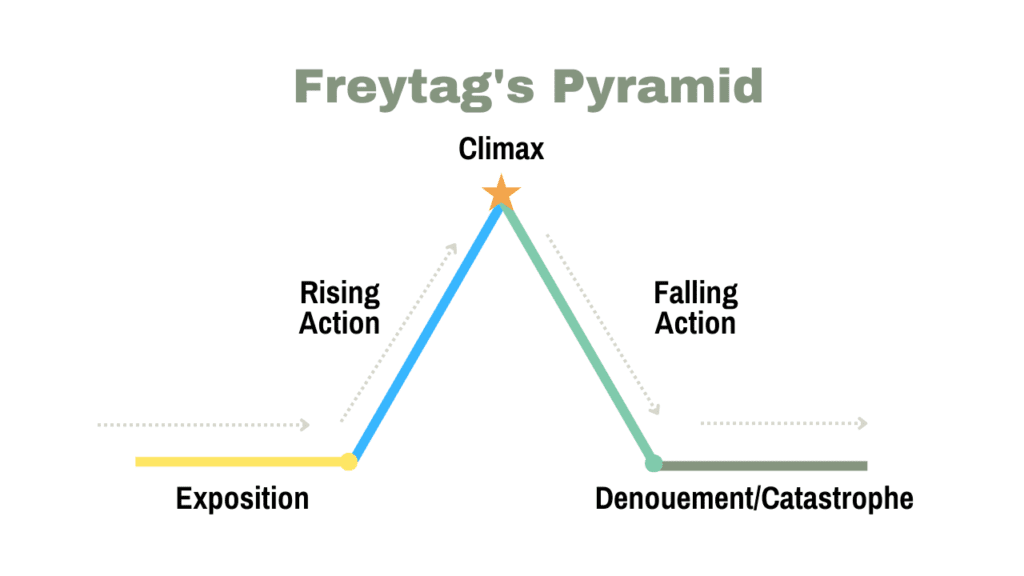
Many stories follow a five-point structure. They are the following:
- Exposition
- Rising Action
- Climax
- Falling Action
- Denouement (or Catastrophe in tragedies)
As we mentioned earlier, each stage moves the story forward and changes the character’s situation in some way.
Tip: If you want a deeper explanation of each stage, learn how to structure a 5-point plot narrative.
What About the 7-Point Structure?

The 7-point story structure, also a common fiction framework, breaks down a story into seven interconnected stages that increase tension, heighten conflict, and propel the protagonist towards change.
This structure differs from more basic storytelling frameworks. How? Well, it allows writers to reverse-engineer, making it easier to create a cause-and-effect progression throughout the story. Here is a closer look at the key plot points of this structure:
Hook
The hook is the opening chapters of the story. It shows the protagonist’s normal world, which is often the opposite of the resolution (more on this later!). It also foreshadows the change that will happen at the end of the story.
For example, in The Matrix, the hook finds Neo living a quiet, repetitive life as a disconnected office worker and hacker, searching the web for answers. This start is a far cry from the Resolution, where he fully accepts his role as “The One.”
Plot Point 1
Plot point 1 is essentially the inciting incident because it breaks the main character’s normal routine and forces them to make a decision.
Take The Matrix, for example, the first plot point happens when Neo takes the red pill and follows Morpheus into the real world. By making this choice, he leaves behind his ordinary life and enters a conflict far bigger and more dangerous than he expected.
Tip: The plot point 1 is often referred to as point of no return.
Pinch 1
In a 7-point structure, there are pinch points (two to be exact). What are they, you ask? Well, pinch points compel the protagonist either to reassess or react.
Coming from plot point 1, the first pinch intensifies the pressure on the protagonist. How? By revealing how dangerous, powerful, or overwhelming the dilemma actually is.
Following our Matrix example, pinch 1 happens after Neo enters the real world and learns the terrifying truth about the Matrix. He discovers humanity is controlled by intelligent machines, watches how dangerous the Agents are, and realizes that escaping the system is far more difficult than simply waking up.
Tip: Pinch 1 is often the moment when the antagonist, the oppressive system, or the main obstacle of the story is revealed.
Midpoint
At the midpoint, the protagonist moves from reacting to events to making yet another decision, especially when the stakes are higher. It usually follows some major epiphany, loss, or a false victory.
Let’s go back to The Matrix. After surviving several dangerous situations and learning more about the Matrix, Neo stops acting like a confused outsider and takes a more active role in fighting the system controlling humanity.
Pinch 2
Pinch 2 is when the pressure is at its highest, and often when the antagonist gains the upper hand, and the protagonist begins to doubt their ability to succeed. The goal? To emotionally challenge the protagonist while making the final victory still uncertain.
The Matrix’s pinch point 2 occurs when Morpheus is captured, and Neo realizes the rebellion is disintegrating. At this point, the agents seem unstoppable, the mission feels impossible, and Neo can help ask himself if he’ll be able to be the hero everyone expects.
Tip: Vanishing all hope in Pinch 2 is a major turning point that pushes the character toward the growth needed for the final confrontation.
Plot Point 2
The second and final plot point pushes the protagonist toward the final confrontation.
After the hopelessness in pinch 2, the character discovers a new strategy, realization, or source of strength that gives them the upper hand. And unlike plot point 1, where the protagonist reacts to the conflict, this moment shows them actively shaping their own path forward.
In The Matrix, plot point 2 occurs when Neo chooses to rescue Morpheus, fully stepping into the role he once feared to accept.
Tip: Plot point 2 combines growth with action. The protagonist uses everything they have learned throughout the story to confront the antagonist or solve the central conflict.
Resolution or Denouement
The final stage is the story’s resolution. It often highlights the results of the character’s journey while revealing how much they have changed since the hook.
Tip: In many stories, the ending contrasts with the beginning to highlight the protagonist’s transformation.
Back in The Matrix, the resolution comes when Neo embraces his role as “The One,” which, in turn, leads him to defeat Agent Smith. And the quiet, uncertain hacker introduced in the Hook is now confident enough to beat the system controlling humanity, completing his narrative arc (from outsider to leader).
Story Plot Point AI Generator
Running out of ideas for your plot points? Enter this prompt in ChatGPT, Perplexity, or Gemini:
You are a story plot point generator. Your role is to help writers develop the key plot points and turning moments in their story based on the 7-point story structure.

For context, a 7-point story structure is divided into the following parts:
- Hook
- Plot point 1
- Pinch point 1
- Midpoint
- Pinch point 2
- Plot point 2
- Resolution

You will only generate ideas for the following:

- Plot point 1: This is the point of no return and acts as the inciting incident.
- Pinch point 1: This increases the pressue to the protagonist, and is often th emoment the antagonis/central obstacle is fully exposed
- Midpoint: This stage shifts the protagonist from reacting to actively deciding, often after a loss or major ephiphany.
- Pinch point 2: The pressure is at its peak, meaning the antagonist gains the upper hands and hope begins to fade. At this stage, the protagonist their abilities.
- Plot point 2: This stage pushes the protagonist toward the final confrontation, and often discovers a new strategy, realization, or strenght.

Output format:
- For each required stage, provide 3 bullet point ideas
- Label each stage clearly before its bullet points
- No hook, no resolution, and no commentary

Rules/constraints
- Every idea must be the specific to the provided information (characters, conflict, context, etc).
- Ideas must reflect the tone and genrea
- Each idea must carry dramatic weight and connect directly the story's central conflict and the protagonist's arc
- Use all user-provided inputs

Use-provided information
Genre: [insert genre]
Story plot/premise: [insert info]
Characters: [list your protagonist, antagonist, and supporting characters. Include their roles and relationships]
Context: [any relevant information like world-building, setting, etc]
Partial draft: [include draft if available]
Final Thoughts
And there you have it! Plot points are pivotal moments that show your protagonist’s thought process and growth. They also give the momentum and pace your story needs to smoothly transition chapter after chapter, and keep readers on the edge of their seats. Remember, plot points are different from a plot!